
The Downing Urn

Still looking through some photos that I took this fall, when we visited Washington, D.C. . .

This slideshow requires JavaScript.

I admired the Andrew Jackson Downing Urn in the Enid A. Haupt Garden behind the Smithsonian Institution Castle. It was designed by Downing’s architectural partner, Calvert Vaux, and sculpted from marble by Robert E. Launitz several years after Downing’s death.

In 1850, Andrew Jackson Downing transformed the Mall into the nation’s first landscaped public park using informal, romantic arrangements of circular carriage drives and plantings of rare American trees. Downing’s design endured until 1934, when the Mall was restored to Pierre L’Enfant’s 1791 plan. Downing (1815-1852), the father of American landscape architecture, also designed the White House and Capitol grounds.

The memorial urn stood on the Mall near the Smithsonian’s National Museum of Natural History for 109 years (1856-1965). In 1972, it was restored and placed on the lawn east of the Smithsonian Building (“Castle”) flag tower. In 1987, it was relocated to the Rose Garden at the Castle’s east door. The urn was moved to its location in the Enid A. Haupt Garden in 1989.”

– text of the plaque near the foot of the urn’s pedestal

I wonder where the urn will go in the new design plans for the area, recently released by the Smithsonian.
Continue reading “The Downing Urn”

Life in gardens: Chamisal

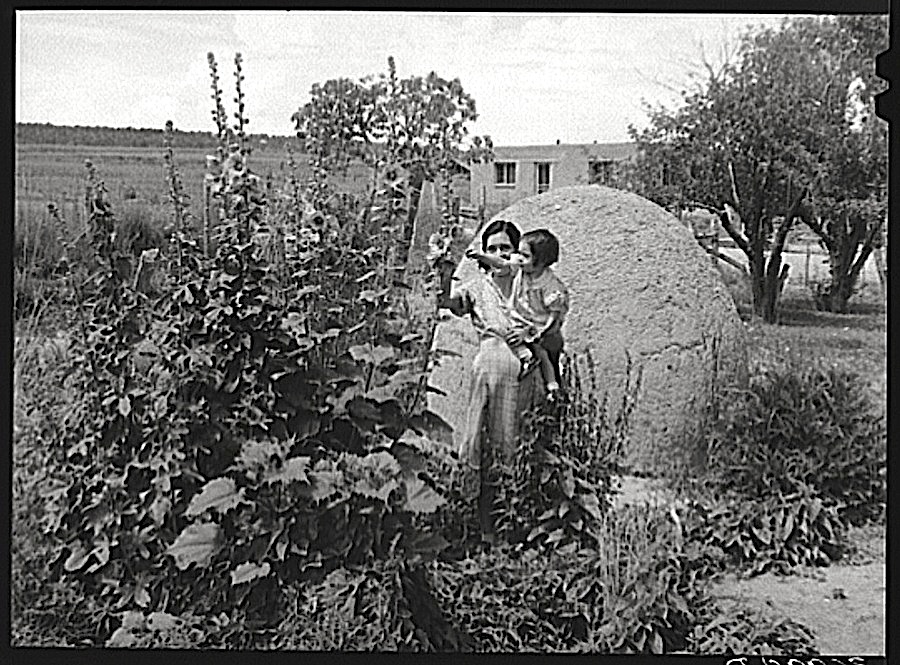
New Mexico, R. Lee, via LoCWoman and baby in a flower garden in front of an adobe oven, July 1940, Chamisal, New Mexico, (along the High Road to Taos) by Russell Lee, via Library of Congress Prints and Photographs Division.

Chamisal was settled by Spanish colonialists in the 18th century.  The name may come from the “chamois” shrub  (Chrysothamnus or rabbitbrush).

Lee and his wife, Jean, spent two weeks in Chamisal and Peñasco documenting the lives of the towns’ Hispanic small farmers and ranchers.

The winding High Road to Taos begins in Santa Fe and crosses the Sangre de Cristo Mountains.  The landscape includes high desert, forest, farms, and historic Spanish Land Grant and Pueblo Indian villages.

Garden classroom, Washington, D.C.

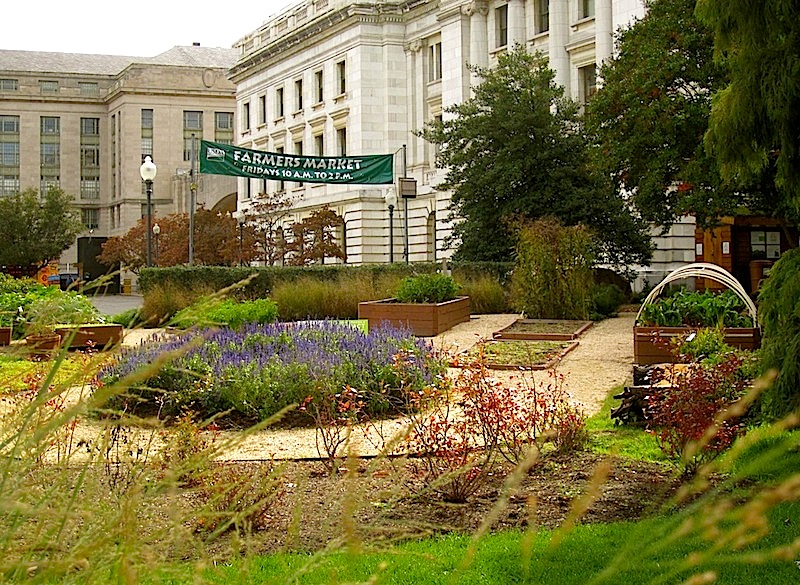
Department of Agriculture, Washington, D.C., October 2014, enclos*ure
In October, during our trip to the U.S., I poked fun at a Bradford pear tree (happily?) missing from the grounds of the U.S. Department of Agriculture (USDA) building on the National Mall.

But I did like all the other American specimen trees there — and the demonstration vegetable and flower garden on the corner of 12th Street and Jefferson Drive, S.W., (across from the Smithsonian Metro stop).

Outdoor classroom, USDA

I particularly liked the seating in what appeared to be an outdoor classroom.

Outdoor classroom, Oct. 2014, USDA

Earlier this year, an interesting 15-year plan was announced to turn all the green space (and parking lots) surrounding the USDA building into a “People’s Garden,” focusing on sustainable cultivation. You can read more about it here.

The Sunday porch: lattice and brick

This slideshow requires JavaScript.

“William Windom house, 1723 de Sales Place, Washington, D.C., Terrace,” ca. 1925, four hand-colored glass lantern slides by Frances Benjamin Johnston, via Library of Congress Prints and Photographs Division.

Johnston used these slides in her “Gardens for City and Suburb” lectures. (You can scroll through larger version by clicking on ‘Continue reading’ below.)

De Sales Place (now Row) is an alleyway between L and M Streets, N.W. (It connects 18th and 19th Streets.) The house is gone; an office building occupies the site.

The William Windom who gave his name to the home was twice Secretary of the Treasury, as well as a Congressman and Senator from Minneasota. He died in 1891. His son, also a William, may have been living in the house at the time of these photos.  He died in 1926.

[We] usually learn that modesty, charm, reliability, freshness, calmness, are as satisfying in a garden as anywhere else.

— Henry Mitchell, from The Essential Earthman

Continue reading “The Sunday porch: lattice and brick”

Urban Bird Habitat Garden

This slideshow requires JavaScript.

Last October, I posted two photos of a nice hellstrip along the west side (12th Street, N.W.) of the Smithsonian’s Museum of Natural History.

In mid October of this year I discovered the Urban Bird Habitat Garden, on the other side of the sidewalk. It’s essentially all the grounds of the museum on the north, west, and south sides (the east side is the Smithsonian’s Butterfly Habitat Garden).

The bird habitat was established in July 2012 (one of twelve Smithsonian gardens). Native trees, shrubs, and perennials were especially chosen to create “an oasis” for many of the more than 300 birds species found in Washington, D.C.

Although the garden is very narrow along 12th Street and the Mall, it was full of birdsong during my visit.

You can click on ‘Continue reading’ below to scroll through larger images of the garden. (And you can see the garden in other seasons here.)

Continue reading “Urban Bird Habitat Garden”