The Sunday porch: interiors

More well-furnished porches in Queensland, Australia. . .
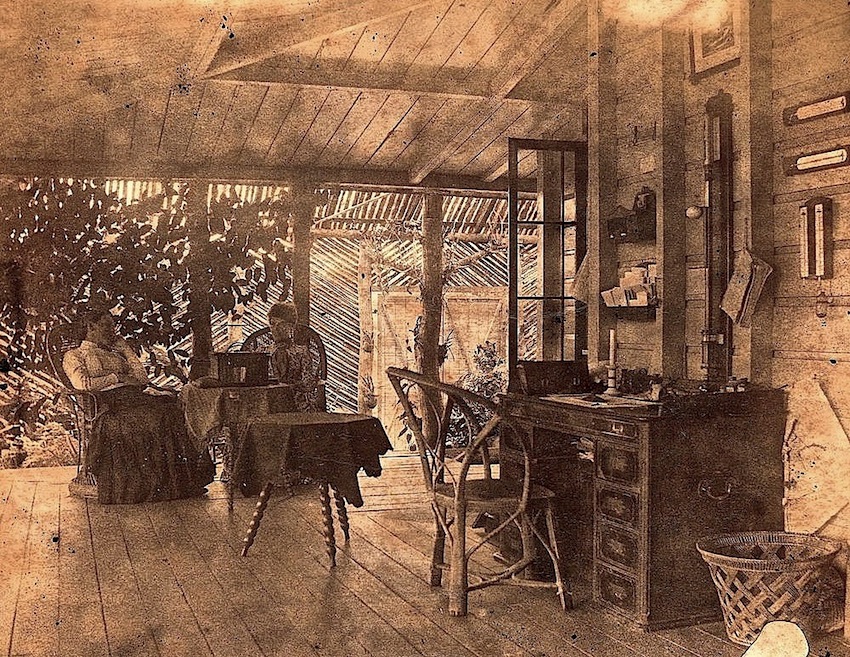
5 Queensland porch interior, late 19th c., StateLibraryQueensland“Verandah at The Hollow, near Mackay, Queensland, about 1875,” photographer unidentified (all photos here), via State Library of Queensland Commons on flickr (all photos here).

I love the office setup on this very deep porch with an adjoining fernery or bush-house. There is also a sewing machine on the table between the two women.

These photos are not very clear, but you can click any thumbnail in the gallery below to scroll through larger versions.  There are four additional pictures there too.
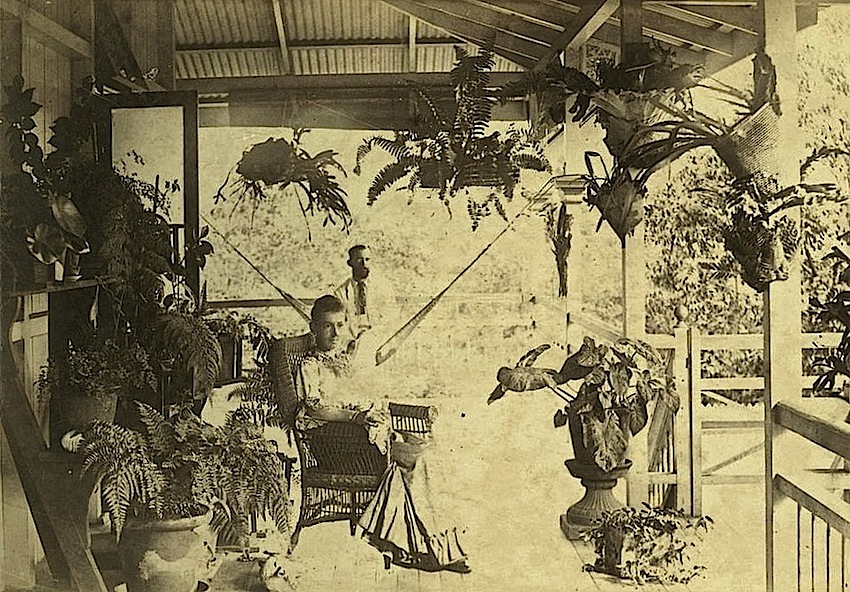
7 Queensland porch interior, late 19th c., StateLibraryQueensland“Unidentified family on the verandah of a Cairns residence, ca. 1895.”

What a beautiful plant collection.

2 Queensland porch interior, late 19th c., StateLibraryQueensland“Furniture on the verandah of a Queenslander home, ca. 1925,” photographer unidentified.

The white chairs on the left with the extended armrests are “squatter’s chairs,” typical to Queensland porches. There are two more examples here.

Additional links:
Gracemere Homestead 1940 photo,  RockhamptonGracemere Homestead in 2001, GracemereHomestead history

W.C. Hume short biography, Brisbane, squatter’s chair

The KingsfordsCairns

Life in gardens: Detroit, Michigan

Detroit wall, 1941, J. Vachon, Library of CongressBlack children standing in front of a half-mile concrete wall  in northwest Detroit. It was built in 1941 to separate their neighborhood from a white housing development going up on the other side.

The photo was taken in August 1941 by John Vachon for U.S. Farm Security Administration and is via Library of Congress Prints and Photographs Division.

The 1930s and 1940s were times of great growth for the city of Detroit and the inner-suburbs. The Federal Housing Administration (FHA), founded in 1934, pushed the idea of home ownership as an accessible goal for the average working class. . . .

[However], the FHA’s policies of mandated racial homogeneity in housing developments and redlining made it difficult for African Americans to become home owners. . . . Between 1930 and 1950, three out of five homes purchased in the United States were financed by FHA, yet less than two percent of the FHA loans were made to non-white home buyers. . . .

Public or private housing being hard to come by in the city, some African Americans were able to purchase land lots around the Wyoming Avenue and 8 Mile intersection with hopes of eventually building houses. . . . When the FHA was approached by a developer wanting to build an all-white subdivision west of the site, funding was refused because the area was too risky for investment. In a compromise with the FHA, the developer erected the wall that was to divide the “slum” from his new construction project.

— “The Detroit Wall,” Wikipedia

Vintage landscape: Pasadena, Calif.

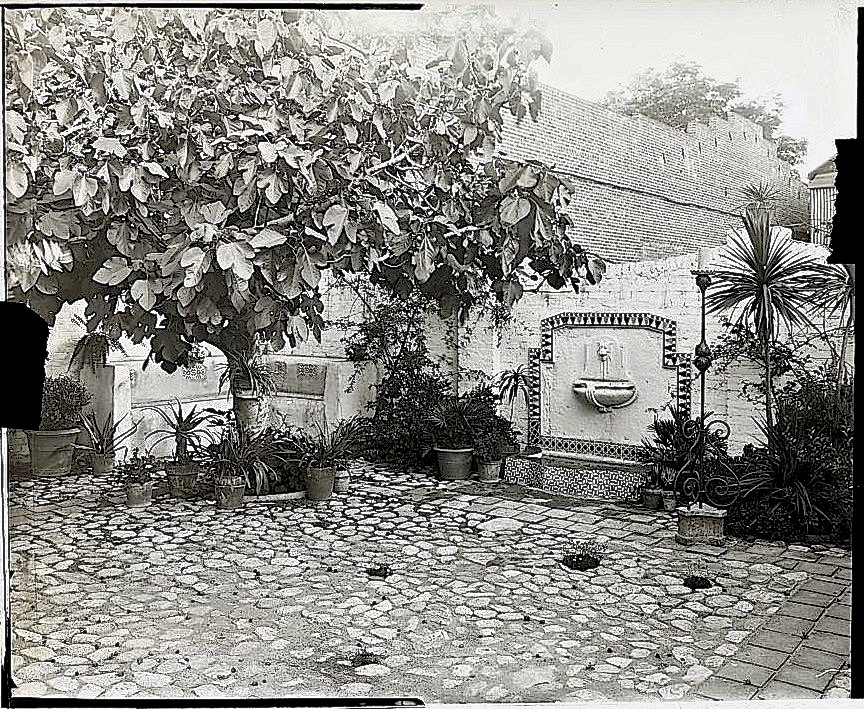
Vroman's Bookstore, Pasadena, CA, FBJohnston, Library of CongressThe patio at Vroman’s Bookstore, 60 E. Colorado Street, Pasadena, California, Spring 1923, by Frances Benjamin Johnston, via Library of Congress Prints and Photographs Division.

Vroman’s Bookstore was founded in 1894 by Adam Clark Vroman and is still a Pasadena cultural institution, with three locations in the city.

However, the little patio above, with its fig tree and fountain, no longer exists. Vroman’s moved to 695 E. Colorado Street in 1929.

Johnston used this image in her garden and historic house lectures.

The Sunday porch: Struan

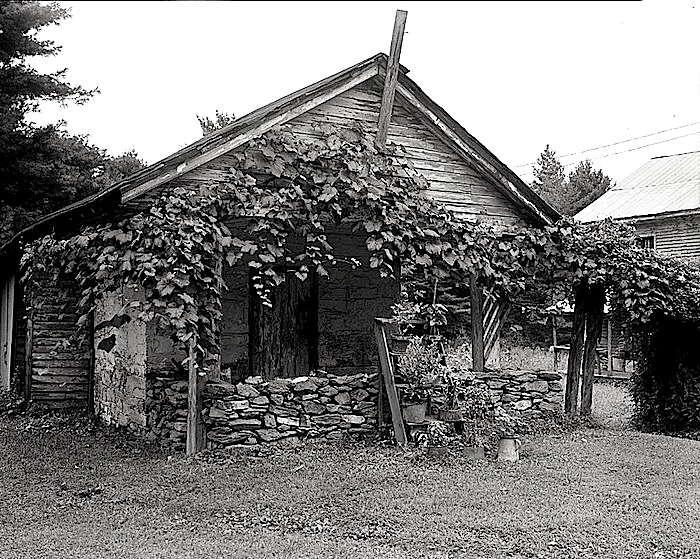
Struan, Arden, North Carolina, via Library of CongressGrape vines over the porch of an old outbuilding at Struan, Arden, North Carolina, 1938, by Frances Benjamin Johnston, via Library of Congress Prints and Photographs Division.

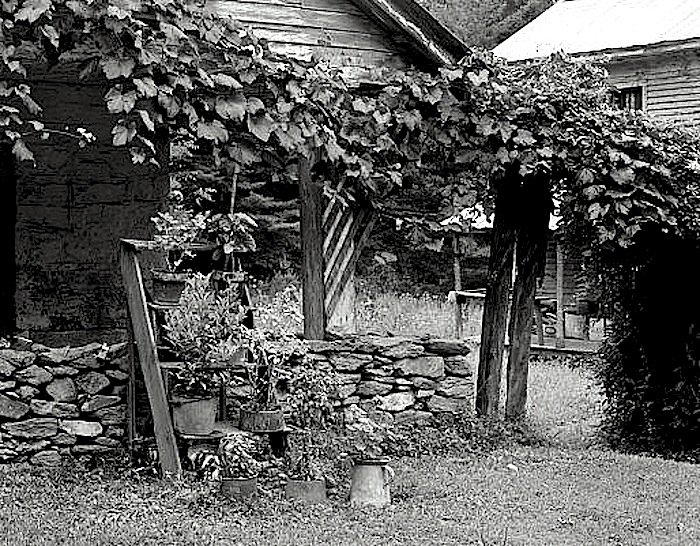
Struan, Arden, North Carolina, cropped, via Library of CongressDetail of the above; note the potted plants on the old ladder.

By the time Johnston photographed the old plantation of Struan for her Carnegie Survey of the Architecture of the South, the property had been a school for boys, Christ School, for 38 years.

Vintage landscape: Birdsnest, Virginia

Bird's Nest Tavern, FBJohston, 1930s, Library of Congress “Old Birds’ Nest Tavern, Marionville vic., Northampton County, [on the Eastern Shore of] Virginia,” ca. 1930s, by Frances Benjamin Johnson, via Library of Congress Prints and Photographs Division. (Marionville was also known as Birdsnest.)

Beautiful summer meadow around the house. . .

Johnston’s notes on the photograph call the building a “sailors’ tavern.” It was probably one half to two miles from the creeks and marshes of Hog Island Bay on the Atlantic Ocean, maybe closer.

Her notes also say that it was “the first three story house in the country [county?].”

According to a 1927 economic and social survey of Northampton County, “[f]rom the low room in the middle of this building originated the name of ‘Bird’s Nest’.”

Unfortunately, I can’t find anything to indicate that it has survived to the present day.

When the world turns completely upside down
You say we’ll emigrate to the Eastern Shore
Aboard a river-boat from Baltimore;
We’ll live among wild peach trees, miles from town, . . .
We’ll swim in milk and honey till we drown.

— Elinor Wylie, from “Wild Peaches