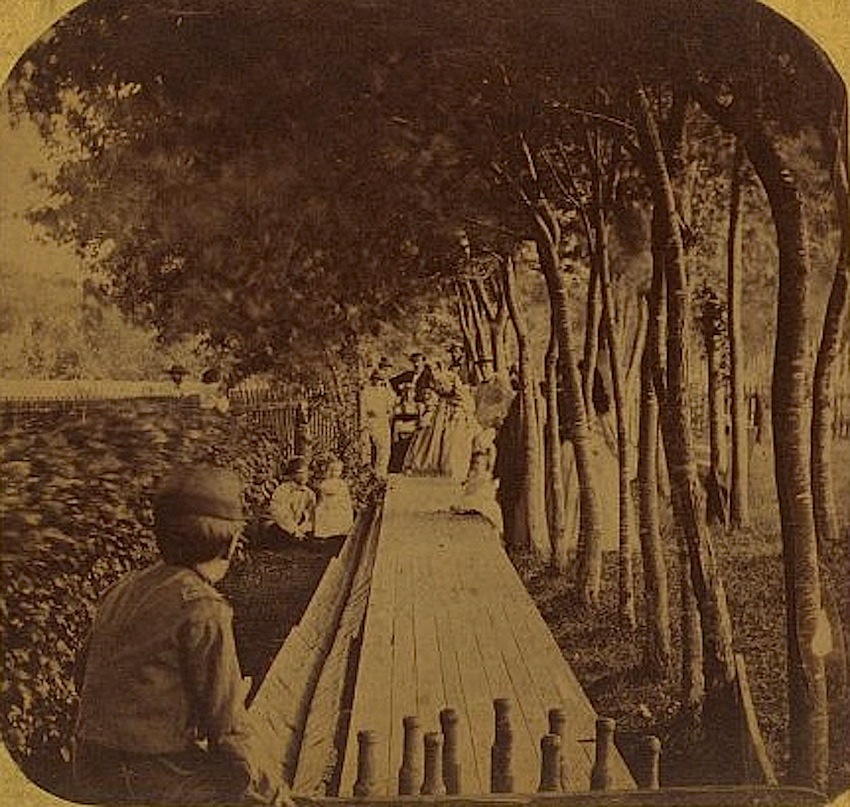
Bowling, 1861


“Group of people bowling on a wooden lane erected in a yard,” July 4, 1861, via Library of Congress Prints and Photographs Division.

I just found this photo. It was taken exactly one year before yesterday’s picture, probably by James Hunter,* who would host the 1862 picnic.

The Library’s online catalogue says that “Mrs. H. Bowling and Coleman Sellers, Jr.,” have been identified in this image, although it doesn’t say where they are — probably the woman bowling (Mrs. H., bowling†) and perhaps the boy in charge of setting up the pins.
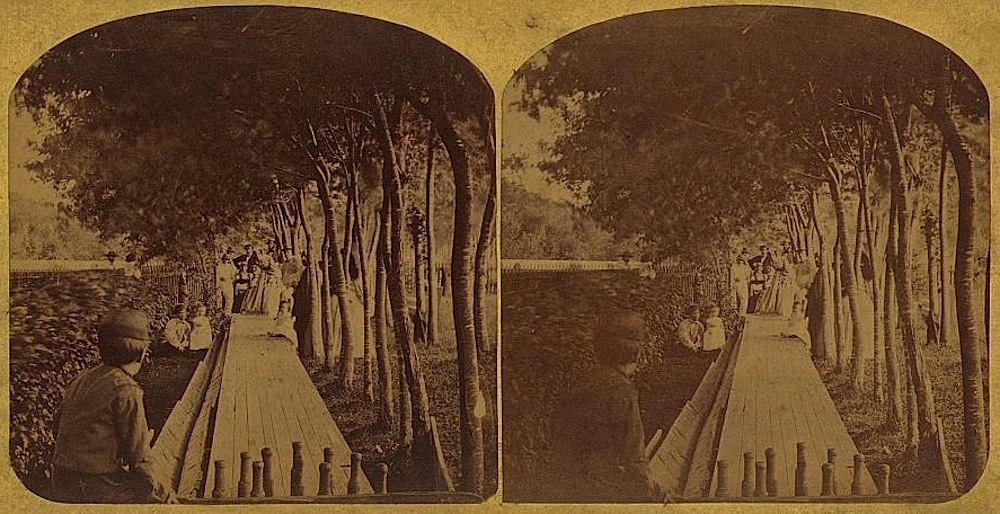
The full stereograph. I do hope they removed the baby from the lane before she bowled.

“By the mid-1800s, the game of ninepins was so popular that wealthy families installed bowling lanes at their estates. . . , ” according to American Profile. “When some states outlawed ninepins [in the 1830s and 40s] because it encouraged gambling, the modern game of tenpins evolved to skirt the laws.” I’m not sure if there are nine pins in this picture or ten. What looks like one middle pin may be two pins lined up.

The image is part of the Charles F. Himes collection of stereographs by amateur photographers, primarily members of the Pennsylvania Photographic Society (1860-61) and the Amateur Photographic Exchange Club (1861-63).


*James Hunter may have been co-owner of the Print and Dye Works in Hestonville, Pennsylvania.

†H. for Hunter? Coleman Junior’s father was Coleman Sellers II, a prominent engineer and inventor from Philadelphia. — as well as an amateur photographer.

Hestonville, Pennsylvania

Fourth of July picnic at Mr. James Hunter‘s, Hestonville, Pennsylvania, 1862, a stereograph by Coleman Sellersvia Library of Congress Prints and Photographs Division.

Hestonville is now a neighborhood of Philadelphia.

The Sunday porch: Hill End


“Two women on veranda of rendered* cottage with shingle roof and front garden, Hill End, New South Wales, ca. 1872,” by Charles Baylissvia National Library of Australia Commons on flickr.

Hill End was a gold rush town. At the time of this photo, “it had a population estimated at 8,000 served by two newspapers, five banks, eight churches, and twenty-eight pubs,” according to Wikipedia. The rush was over by the early 20th century. In 2006, the town was down to 166 people.

The photographer came to Hill End as an assistant to a traveling photographer who had been contracted to take pictures of the area that could be used to advertise the mining colony and attract new residents.


*Render is stucco.

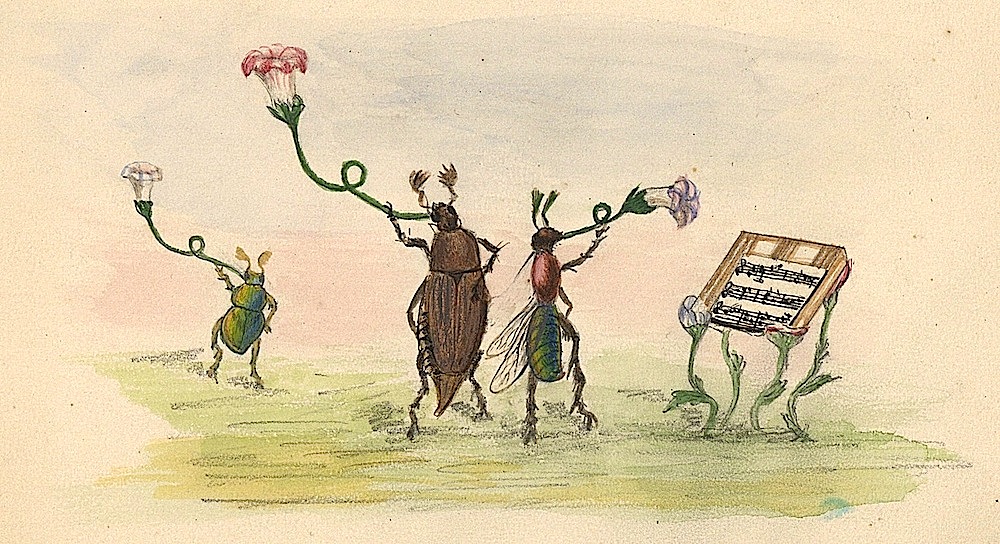
Põrnikate orkester

“Beetle orchestra,” artist and date unknown, via National Archives of Estonia Commons on flickr.

The pencil and watercolor drawing comes from an album of poetry and fanciful sketches of bugs and birds.  It was found in the 18th century manor house of the Saadjärve estate, which has belonged to several noble Baltic German families over the centuries. The album may be connected to the von Koskulls, who owned the property in the 19th century. There are more examples of the drawings here.

By the way, an Instagram post by @smithsoniangardens reminds us that although “[t]hey may be less elegant than other pollinators, . . . beetles have been providing their pollination services far longer than many of the well-known pollinators. Ancient and abundant in numbers, there are almost four times as many species of beetles as animals with backbones!” (This is Pollinator Week.)

As always, you can click on the image for a little better view.

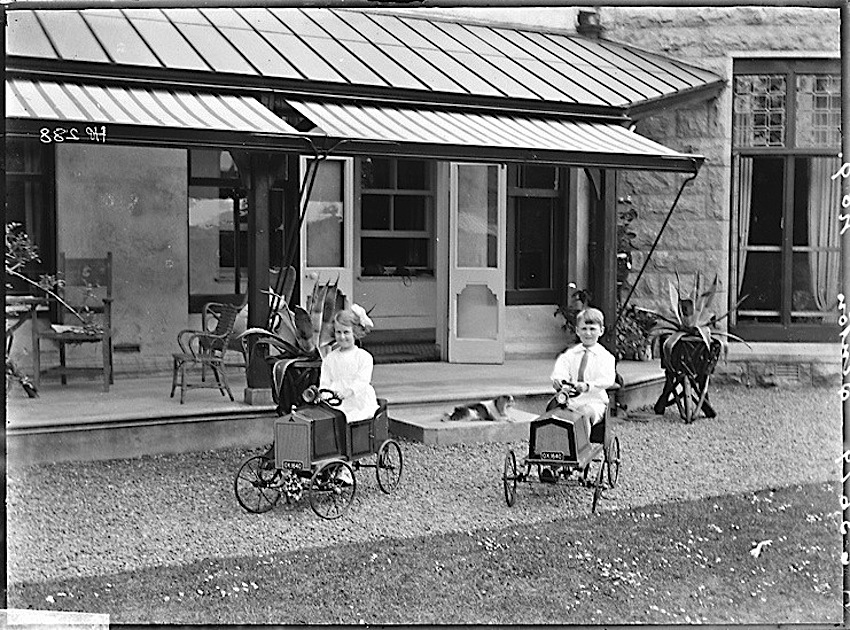
The Sunday porch: County Armagh

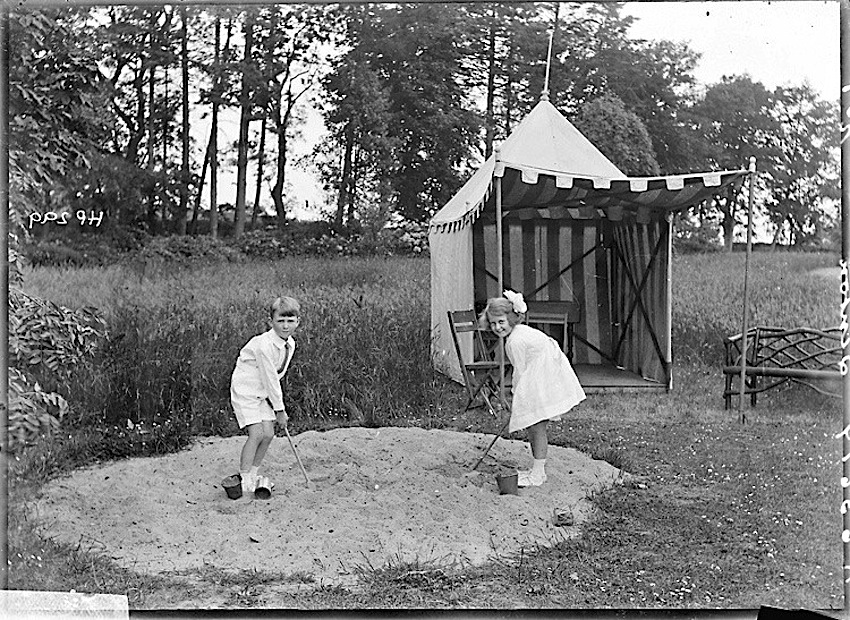
Bridget and Maynard Sinton at their family home of Ballyards, County Armagh, June 17, 1921, by H. Allison & Co. Photographers, via Public Record Office of Northern Ireland Commons on flickr.

That retractable striped awning emerging from the terrace roof looks very sleek and was brand new.  A ca. 1920 photo of the house in this biography of the children’s father shows the terrace with no cover. (You can read a brief history of awnings here.)

Ballyards was built in 1872 and sold to the father, a linen manufacturer, in 1908. He almost doubled its size and called it “Ballyards Castle.”

The children playing in a sandpile. (This photo has been printed in reverse from the others.)

Maynard was killed in WWII, but Bridget (age 7 in these photos) lived until 1975.