
 “Heijlo, 1789,” the Straatweg (main street), Heiloo, Netherlands, ca. 1900, by C.W. Bruinvis, via Regionaal Archief Alkmaar Commons on flickr.
Category: art
The Sunday porch: Strasbourg, France

We spent Thursday through Saturday this week in Strasbourg, and a highlight of this trip for me — aside from two great meals (here and here) — was a visit to the Église protestante Saint-Pierre-le-Jeune or Young* Saint Peter’s Protestant Church.
The church has the oldest surviving cloister “north of the Alps,” according to its website.
Three of the four galleries were constructed in the Romanesque style in the 11th century. The fourth, shown above and in the three photos below, was completed in the 14th century in the Gothic style.

The gallery shown above and below was set up for a performance that day.
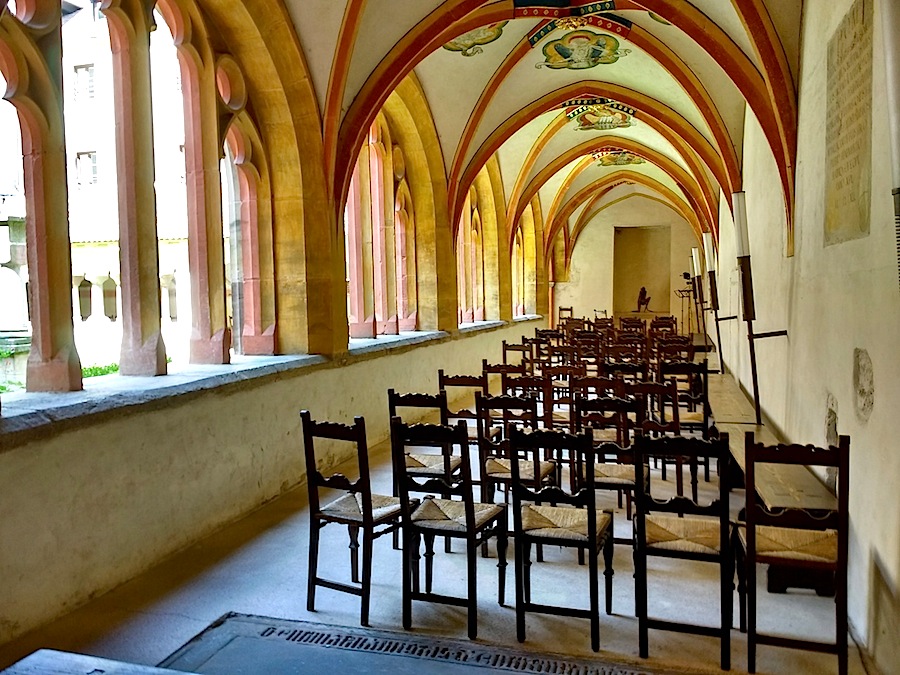

Behind the small stage was a modern sculpture. There were modern works throughout the church. (Unfortunately, I didn’t think to photograph their labels.)

Above: a Romanesque gallery, also ready for a performance or lecture. I loved the pretty chairs, used throughout the church.

A stone mason’s mark?

Above and below: the garden in the center.
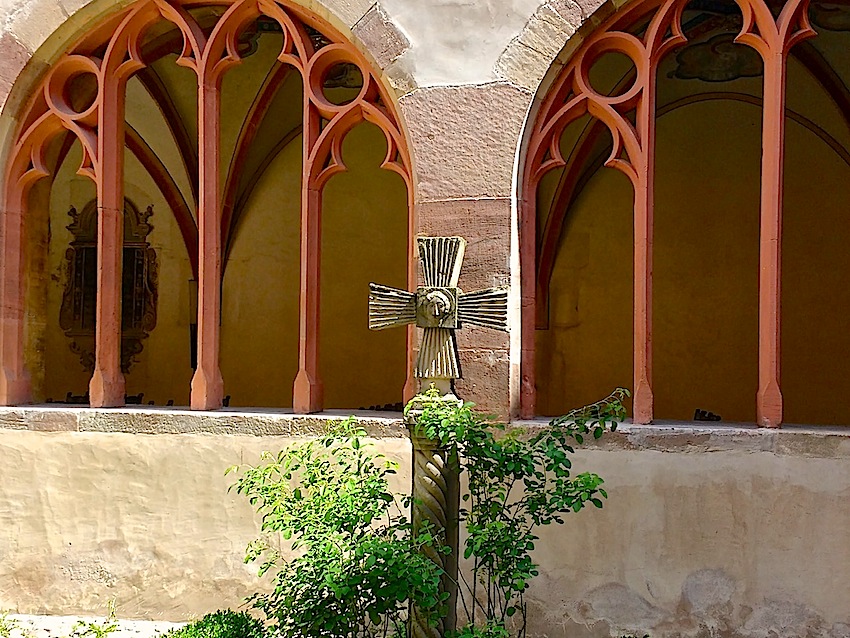
The cloister was heavily damaged and partly buried in the 1700s and then re-built in other ways. After the French revolution, the site was privatized — serving over the years as a wine cellar, a cloth factory, and apartments. It was restored to its original appearance between 2000 and 2008.

On the inside, Église Saint-Pierre is remarkable for its array of colors and forms. The church was built in the 14th and 15th centuries in the Romanesque and Gothic styles.
Originally Catholic, of course, in 1524, it became Protestant. Then in 1682, Louis XIV gave over the choir area behind the rood screen for the exclusive use of the Catholic parish. A dividing wall was built, and it remained there until 1898, when the Catholic congregation moved to its own “Young Saint Peter’s.” In the meantime, in the 18th century, the choir had been redecorated in the Baroque style, in green and gold. Continue reading “The Sunday porch: Strasbourg, France”
Life in gardens: Kolín
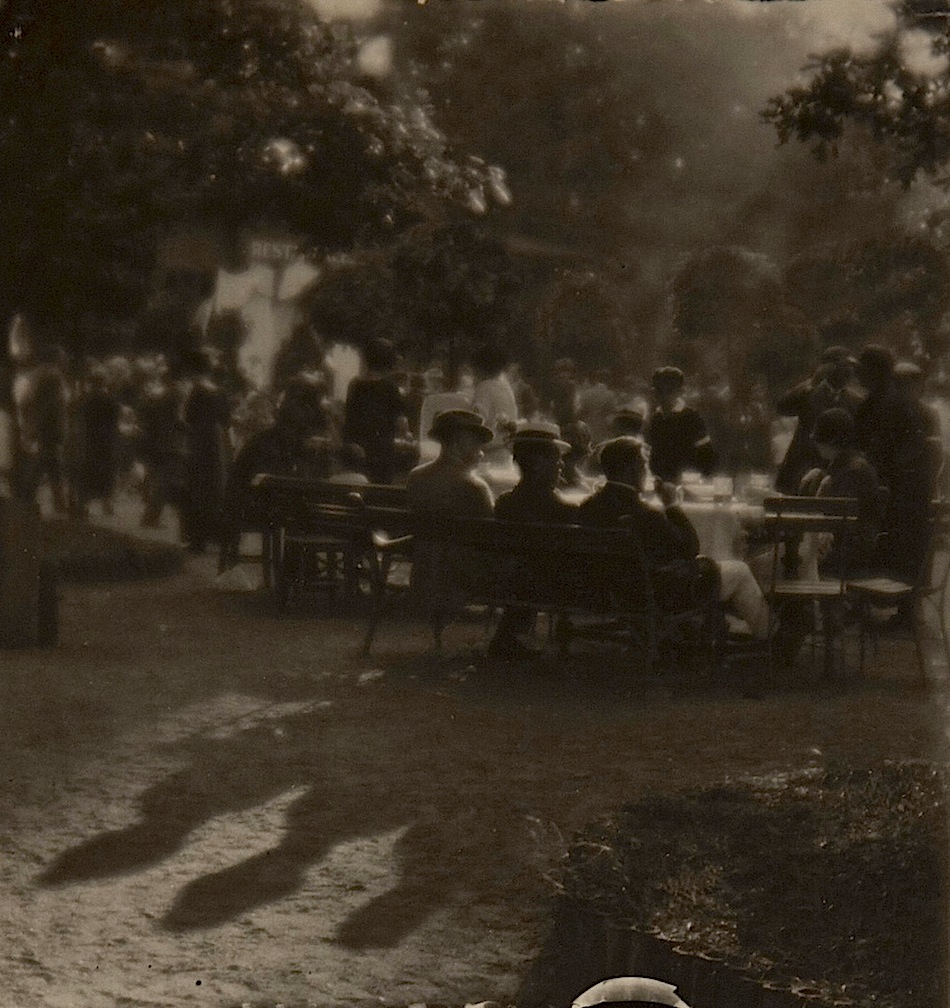
“Sunday Afternoon on Kolín Island,” Czech Republic, 1922, by Joseph Sudek, via Museum of Photographic Arts Commons on flickr.
Life in gardens: natural light

Elizabeth and Marilyn Watson, probably in the Berkeley, California, area, 1921, by Dorothea Lange, via Museum of Photographic Arts Commons on flickr (all photos here).
 Above, Marilyn Watson; in both photos, the sisters seem to be under a grape arbor. Below, they are with their mother, May V. Landis Watson, still outdoors, I believe.

In 1921, Lange was 26 years old and running her own portrait studio in Berkeley. She had many well-to-do clients, as the Watsons appear to be. Ten years later, she would begin the work that made her famous: capturing the faces of the Great Depression and of the WWII internment of Japanese-Americans.
There’s a little clip from a PBS documentary on Lange here. It shows a number of her early photographs.
Vintage landscape: Lacock Abbey
 “Lady Elisabeth’s Rose Garden, Lacock [Abbey], England,” early 1840s, by William Henry Fox Talbot, via Museum of Photographic Arts Commons on flickr (both photos).
Lady Elizabeth Fox-Strangways Feilding was the photographer’s mother.
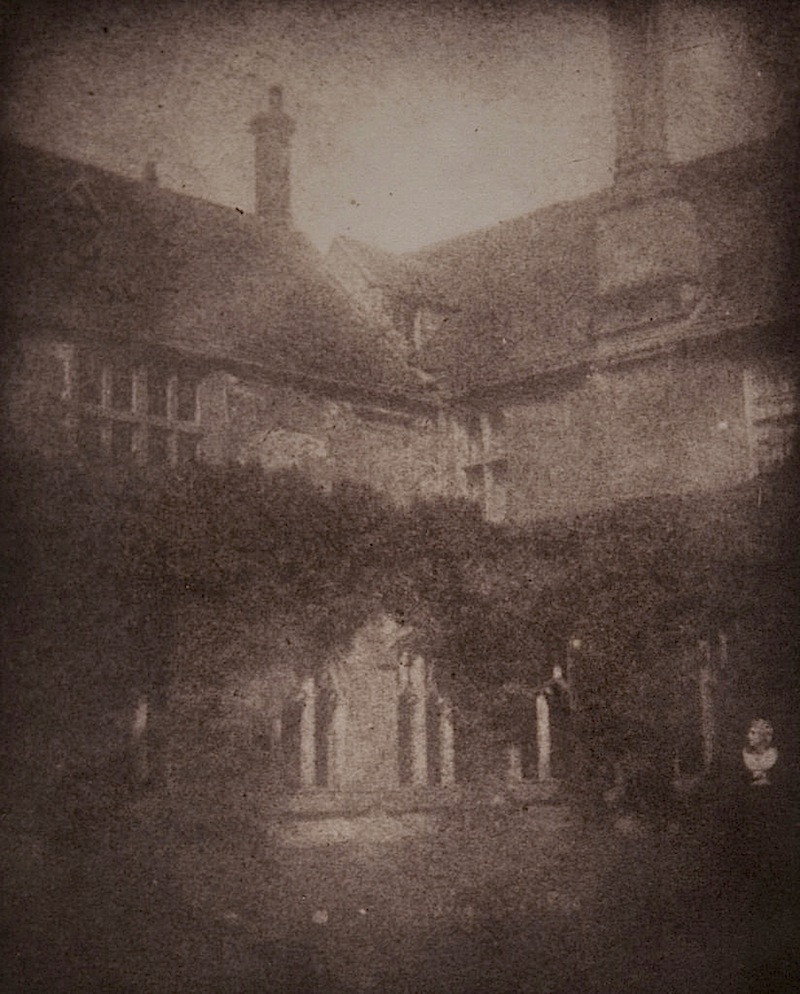
Talbot was one of the early fathers of photography. He developed the paper negative and the process of permanently fixing photos on chemically treated paper.
This is the body of light. . . .
— Ronald Johnson, from “BEAM 30: The Garden“
 enclos*ure