The Sunday porch: Strasbourg, France

St. Pierre le Jeune 5, Strasbourg, Aug2016, by enclos*ure

We spent Thursday through Saturday this week in Strasbourg, and a highlight of this trip for me — aside from two great meals (here and here) — was a visit to the Église protestante Saint-Pierre-le-Jeune or Young* Saint Peter’s Protestant Church.

The church has the oldest surviving cloister “north of the Alps,” according to its website.

Three of the four galleries were constructed in the Romanesque style in the 11th century. The fourth, shown above and in the three photos below, was completed in the 14th century in the Gothic style.

St. Pierre le Jeune 6, Strasbourg, Aug2016, by enclos*ure

The gallery shown above and below was set up for a performance that day.
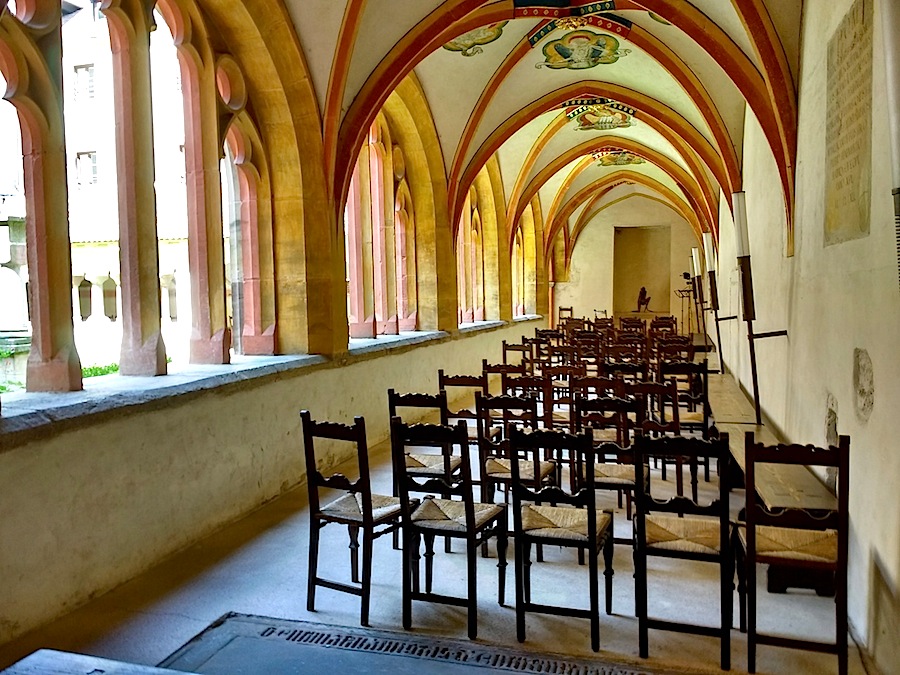
St. Pierre le Jeune 1, Strasbourg, Aug2016, by enclos*ure

St. Pierre le Jeune 7, Strasbourg, Aug2016, by enclos*ure
Behind the small stage was a modern sculpture. There were modern works throughout the church. (Unfortunately, I didn’t think to photograph their labels.)

St. Pierre le Jeune 8, Strasbourg, Aug2016, by enclos*ure

Above: a Romanesque gallery, also ready for a performance or lecture. I loved the pretty chairs, used throughout the church.

St. Pierre le Jeune 2, Strasbourg, Aug2016, by enclos*ure
A stone mason’s mark?

St. Pierre le Jeune 11, Strasbourg, Aug2016, by enclos*ure
Above and below: the garden in the center.
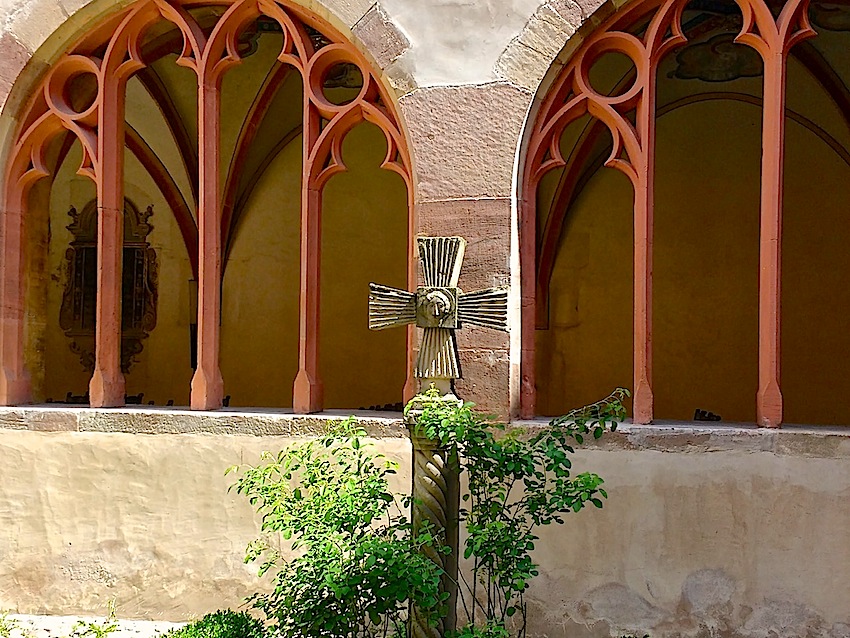
St. Pierre le Jeune 9, Strasbourg, Aug2016, by enclos*ure

The cloister was heavily damaged and partly buried in the 1700s and then re-built in other ways. After the French revolution, the site was privatized — serving over the years as a wine cellar, a cloth factory, and apartments. It was restored to its original appearance between 2000 and 2008.

St. Pierre le Jeune 12, Strasbourg, Aug2016, by enclos*ure
On the inside, Église Saint-Pierre is remarkable for its array of colors and forms. The church was built in the 14th and 15th centuries in the Romanesque and Gothic styles.

Originally Catholic, of course, in 1524, it became Protestant.  Then in 1682, Louis XIV gave over the choir area behind the rood screen for the exclusive use of the Catholic parish. A dividing wall was built, and it remained there until 1898, when the Catholic congregation moved to its own “Young Saint Peter’s.”  In the meantime, in the 18th century, the choir had been redecorated in the Baroque style, in green and gold. Continue reading “The Sunday porch: Strasbourg, France”
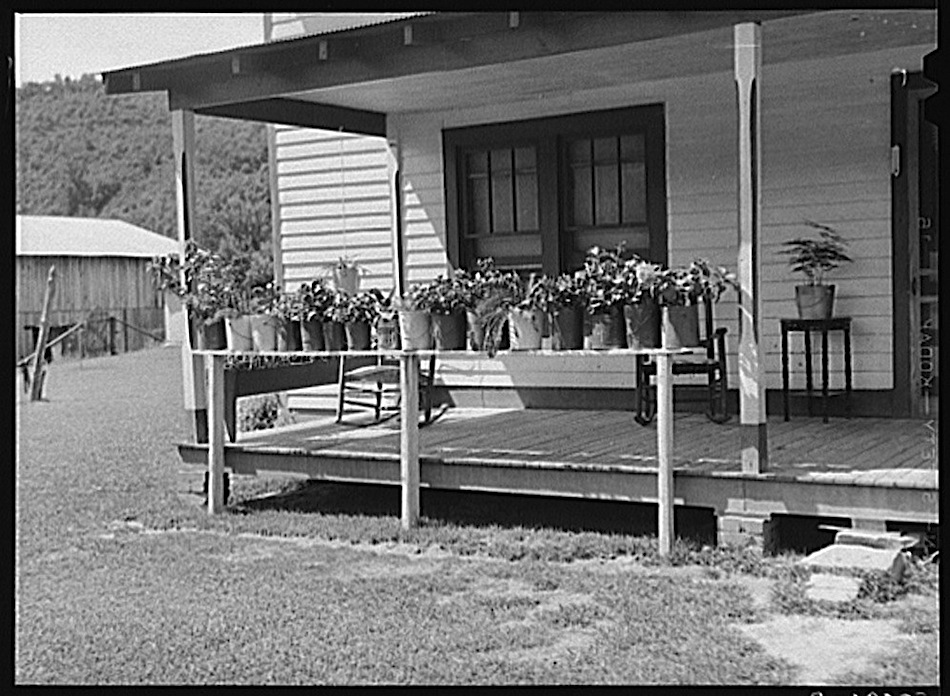
The Sunday porch: Kentucky

Prosperous farmer 1, Kentucky, Library of CongressFarmhouse porch with plants in painted lard buckets, Morehead, Kentucky, 1940, by Marion Post Wolcott for U.S. Farm Security Administration/Office of War Information, via Library of Congress Prints and Photographs Division.

I wish we could see the colors of the painted* containers.

Prosperous farmer 2, Kentucky, Library of Congress
Two special supports were built along the front of the porch to display the plants. (There’s a third view of the house here.)


*Here, here, and here are examples of 1930s interior paint color combinations.

Life in gardens: Galveston, Texas

Lawn tennis in Texas, Texas State Archives
Two women playing badminton or lawn tennis while others look on, “The Oaks,” Galveston,Texas, ca. 1900, via Texas State Archives Commons on flickr.

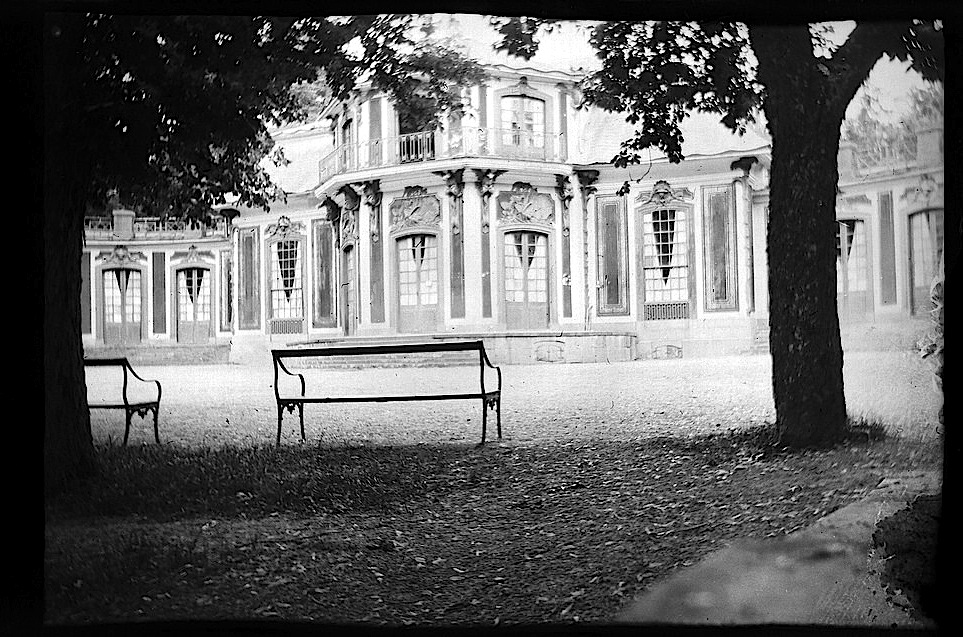
Vintage landscape: Baroque

park benches, ca. 1900, Finnish National Gallery
The park of a Baroque villa or palace, location unknown, 1900, by Hugo Simberginvia Finnish National Gallery on flickr.

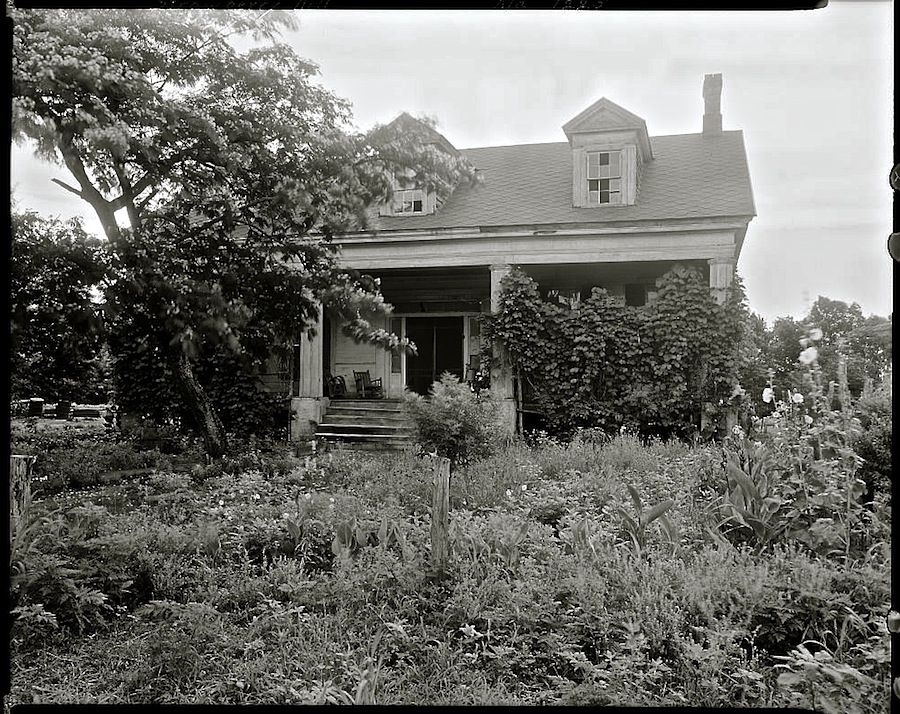
The Sunday porch: Strawberry Hill

My first “Sunday porch,” from August 2013. . .
Vintage Photo of Strawberry Hill, Forkland vic., Greene County, Alabama, via Library of Congress Prints and Photographs Division Strawberry Hill plantation, Greene County, Alabama, in 1939, by Frances Benjamin Johnston, via Library of Congress Prints and Photographs Division.

The front porch is often a box seat for the theater of the garden or the street.  This one seems to have half drawn its curtains against the buzzing, chirping action of the cottage garden below.

Strawberry Hill, 1936, HABS, Library of Congress
Strawberry Hill, November 1936, by Alex Bush, for HABS, via Library of Congress.

The mid-19th century house still exists, although without the vines and flowers.  Its surrounding land is now a cattle ranch.