
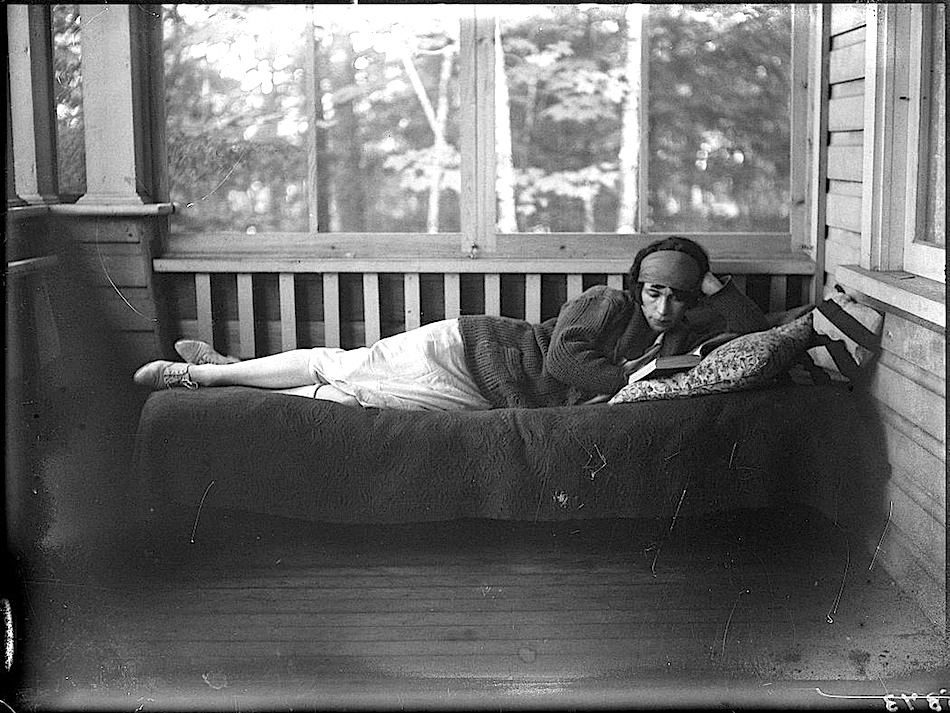
 “M. Laing reading on porch at Bala, July 29, 1925,” via The Globe and Mail Collections (1266, item 5873), City of Toronto Archives.
‘Bala’ is probably Bala, Ontario, a summer cottage community north of Toronto.

“Dining Room of Christian Kold School,” near Odense, Denmark, ca. 1915, an instructional hand-colored lantern slides, via OSU Special Collections & Archives (Oregon State University) Commons on flickr.
I like the repetition of white squares and the somewhat wilted cornflowers (?) across the room. The slide was used during university lectures, possibly about alternative educational methods, including the Danish folk high school movement.
Perhaps the outstanding feature of the Folk High [S]chools is the sociability which is developed. Dining quarters are provided for all students and in the dining room the faculty and students always eat together. . . .
— Image caption from the lecture booklet
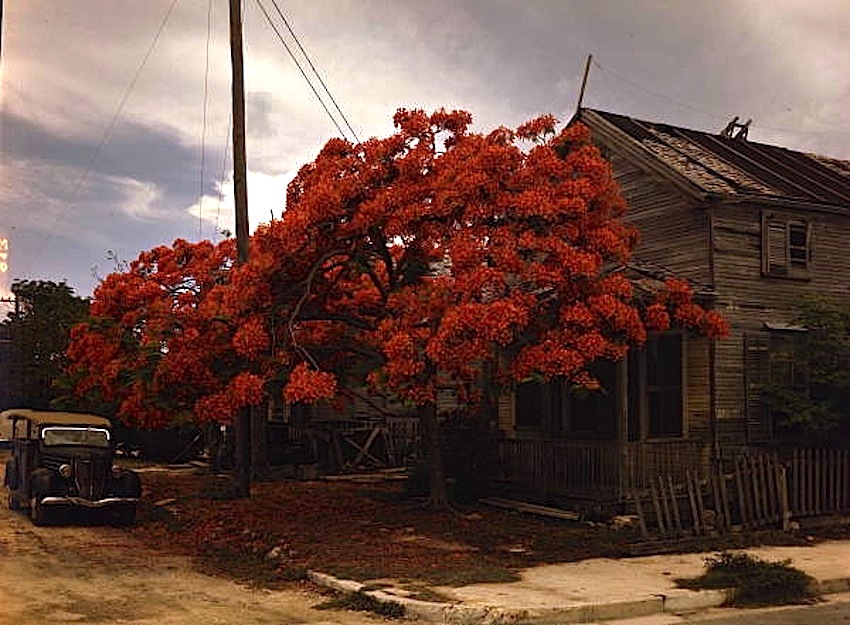 Royal Poinciana (Delonix regia) in bloom, Key West, Florida, ca. 1945, by Joseph Janney Steinmetz, via Florida Memory (State Library and Archives of Florida) Commons on flickr.
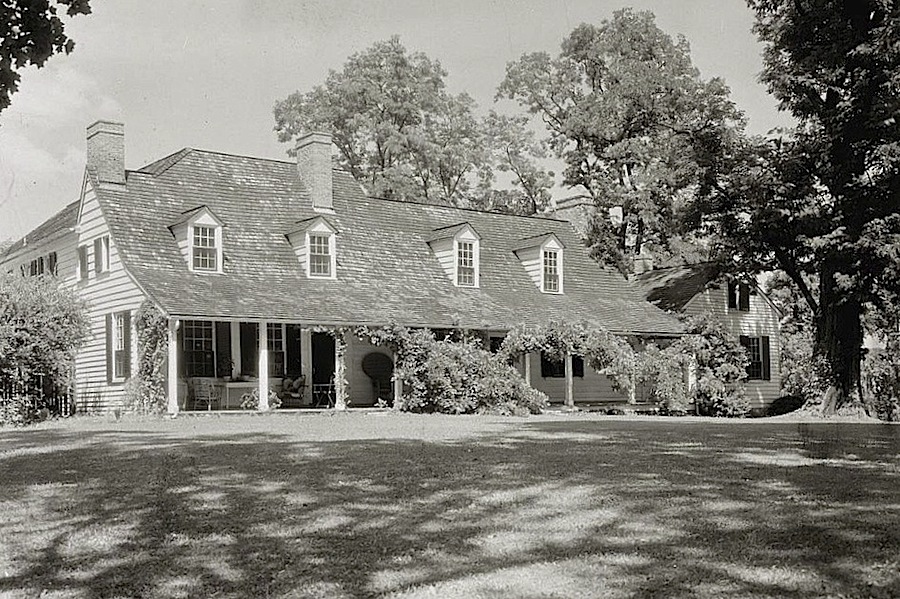
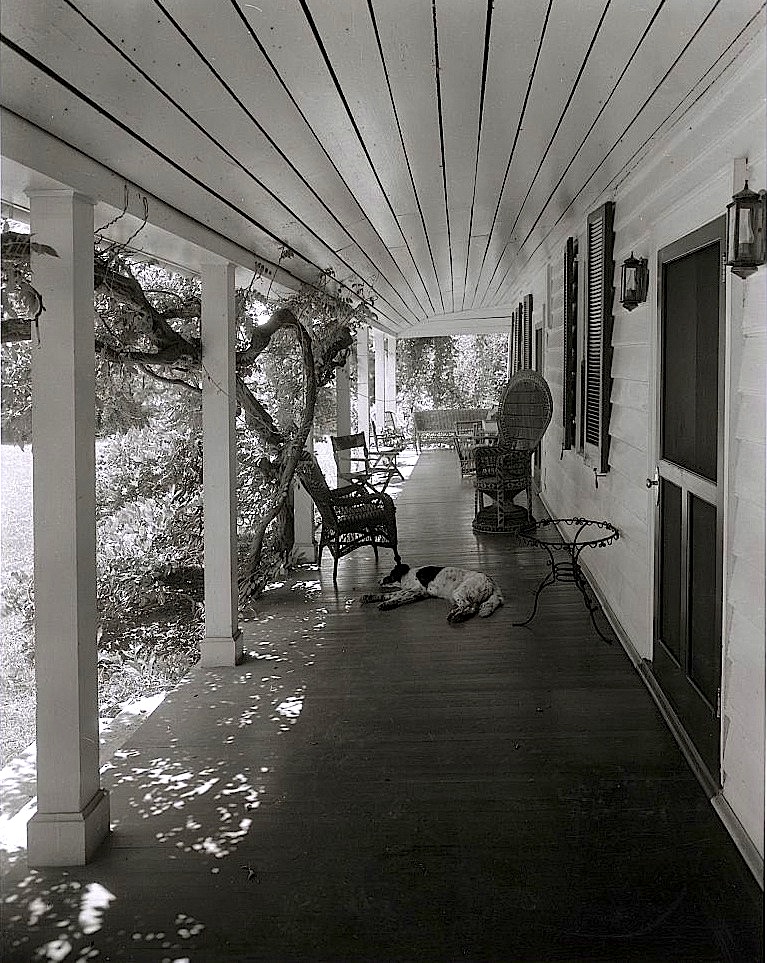 Owings Mills, near Baltimore, Maryland, July 1933, by Frances Benjamin Johnston, via
Library of Congress Prints and Photographs Division (both photos).
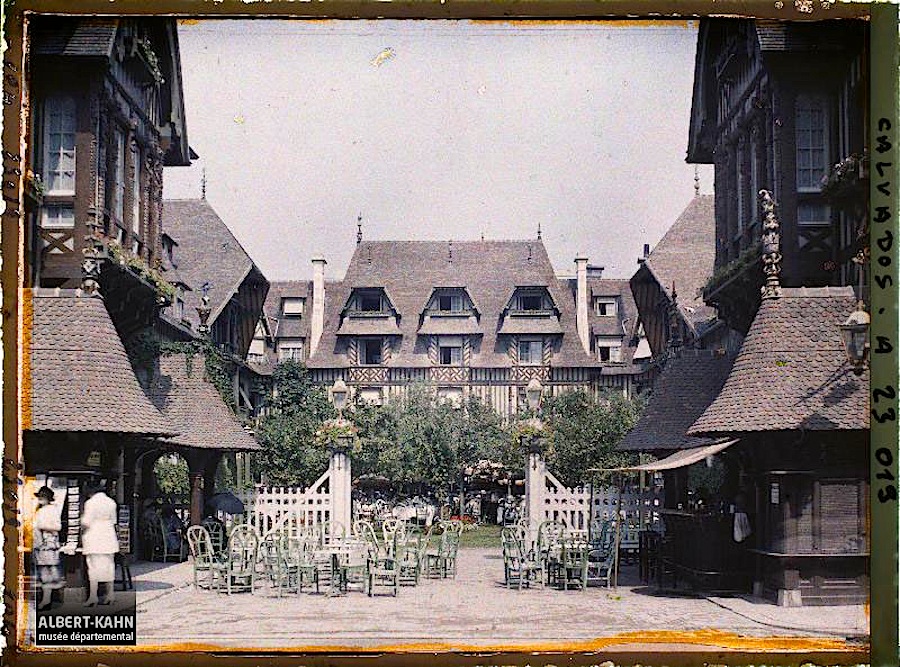
The courtyard of Le Normandy Hotel, Deauville, France, August 8, 1920, an autochrome by Georges Chevalier, via Archives of the Planet Collection – Albert Kahn Museum /Département des Hauts-de-Seine.
Such pretty little green chairs; here’s another photo. . .
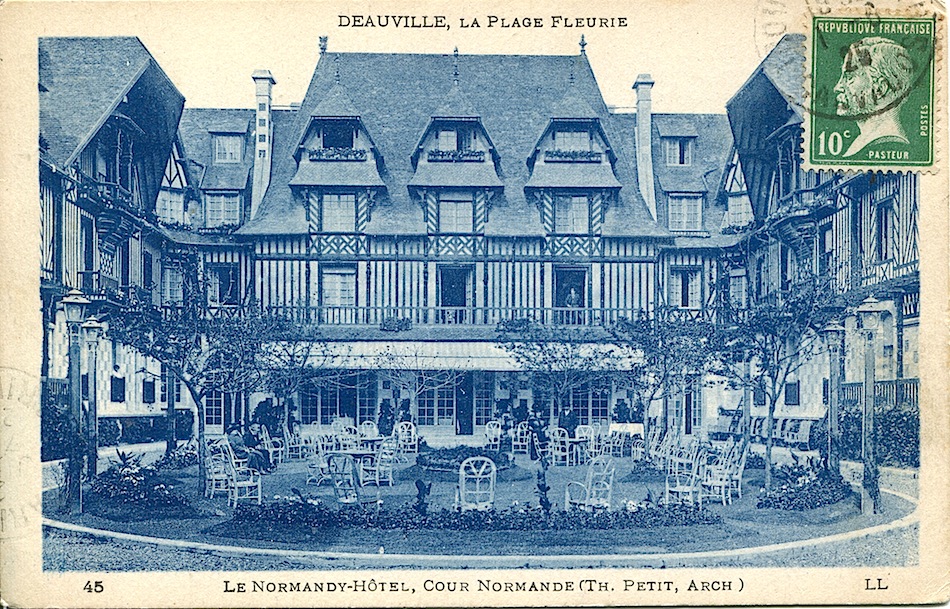
The 5-star hotel was built in an Anglo-Norman style in 1912. It appeared in the 1996 “The Murder on the Links” episode of Agatha Christies’ Poirot with David Suchet. Today, the courtyard looks much the same as it did in the 1920s, although the chairs and tables have been replaced with more little trees.
The image at the top is one of about seventy-two thousand that were commissioned and then archived by Albert Kahn, a wealthy French banker and pacifist, between 1909 and 1931. Kahn sent thirteen photographers and filmmakers to fifty countries “to fix, once and for all, aspects, practices, and modes of human activity whose fatal disappearance is no longer ‘a matter of time.'”* The resulting collection is called Archives de la Planète and now resides in its own museum at Kahn’s old suburban estate at Boulogne-Billancourt, just west of Paris. Since June 2016, the archive has also been available for viewing online here.
*words of Albert Kahn, 1912. Also, the photo at the top (A 23 019) is © Collection Archives de la Planète – Musée Albert-Kahn and used under its terms, here.

