Vintage landscape: tranquility

Tranquilly, by Eleanor Butler Roosevelt

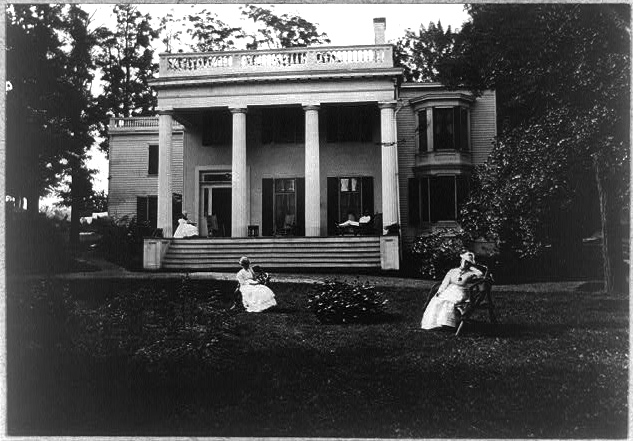
The photo shows Tranquility, the rented summer home of the Theodore Roosevelt family at Oyster Bay Cove, New York, in 1872. The photographer is unknown.

Mr. and Mrs. Roosevelt — the parents of future President Theodore Roosevelt — lounge on the verandah; Edith Kermit Carow (later Mrs. Theodore Roosevelt) and Corinne Roosevelt are on the lawn. The house was demolished in the mid-1940s.

The picture is from scrapbooks Eleanor Butler Roosevelt, daughter-in-law of the President, via the Library of Congress Prints and Photographs Division.

. . .   so sweet as drowsy noons,
And evenings steep’d in honey’d indolence;
O, for an age so shelter’d from annoy,
That I may never know how change the moons,
Or hear the voice of busy common-sense!

— John Keats, from “Ode on Indolence

Vintage landscape: the national tree

White House, 19 December 1939, via LoC

On December 19, 1939 — in the photo above — the White House was being decorated for Christmas.  But the “gayly colored” lights on the wreath and trees would not be lit until Christmas Eve when President Roosevelt would also light the “community Xmas tree.”

At that time, what is now known as the National Christmas Tree was called the National Community Christmas Tree (I like that).

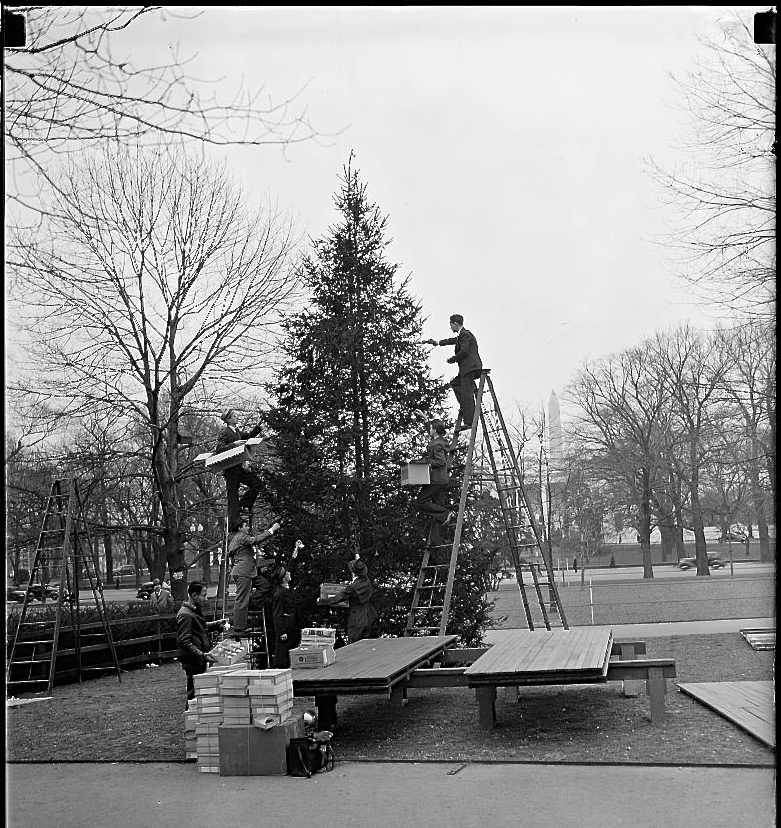
For most of the 1930s, the tree was installed in Lafayette Park, on the north side of the White House.  In the photo below, workers (in suits) decorate the 1937 tree on December 23.

1930's tree, L0C

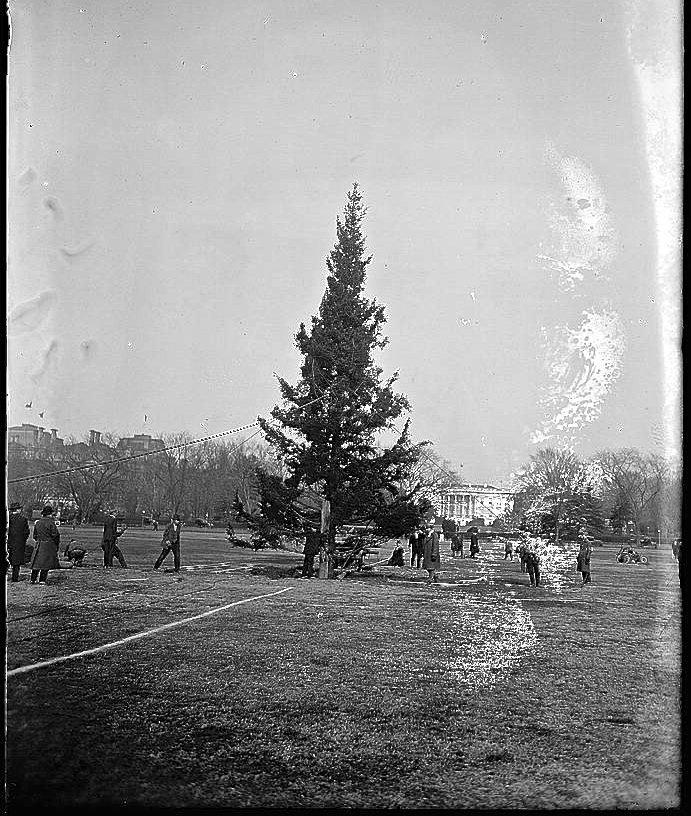
However, the first national tree had been placed on The Ellipse (also its current location), on the south side of the White House, in 1923 (below).

1923 tree setup, L0C

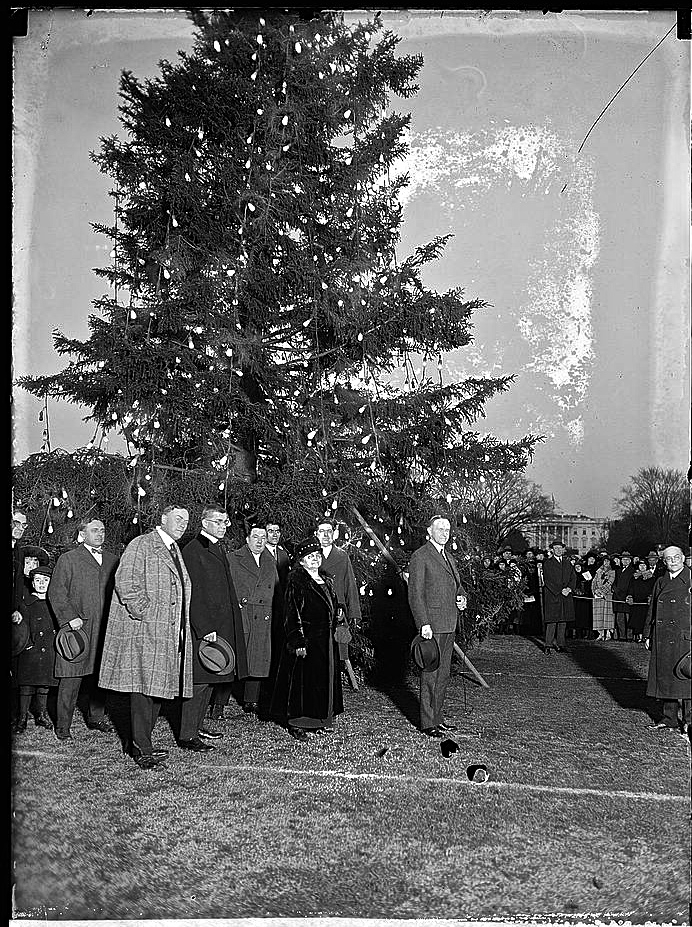
In the early 1920s, according to Wikipedia, “The Society for Electrical Development (an electrical industry trade group) was looking for a way to encourage people to purchase more electric Christmas lights and use electricity, and [Frederick Morris] Feiker [past editor of Electrical World] suggested that President Calvin Coolidge personally light the tree as a way of giving Christmas lights prominence and social cachet.”

The 48′ tall balsam fir was cut and donated by Middlebury College in the President’s home state of Vermont. The Electric League of Washington donated the 2,500 red, green, and white lights.

1923 tree, LoC

President Coolidge lit the tree on Christmas Eve without making any remarks (below).  A two-hour music concert was then held. Wikipedia notes that “after the white residents of the city had dispersed, African American residents of the city were permitted on the park grounds to see the National Christmas Tree.”

1923 tree lighting, LoC

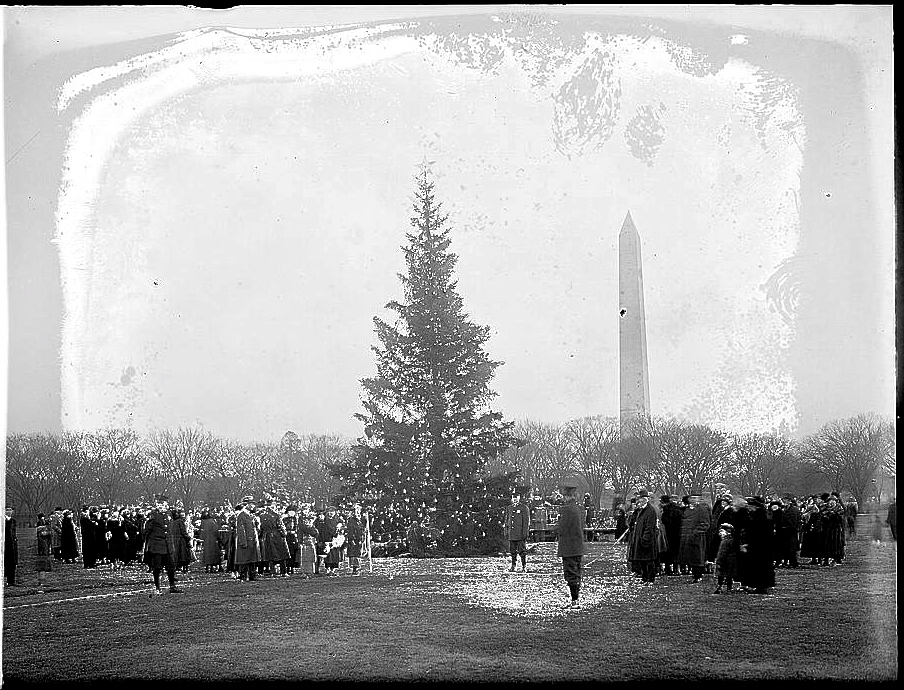
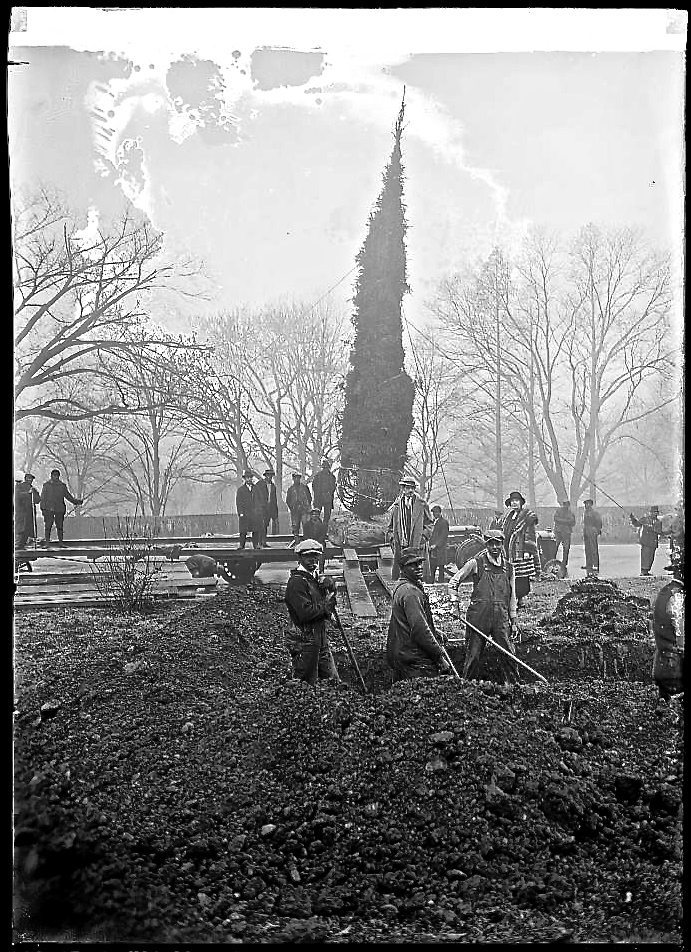
On December 17, 1924 (below), a live “community” tree was planted in Sherman Park (just southeast of the White House).  This had become necessary after Coolidge, speaking before the American Forestry Association that April, had criticized cutting trees for Christmas decorations. (The national tree had to be replaced in 1929 and has been replaced many times since. From the early 50s to the early 70s, cut trees were used.)

1924 tree planted, LoC

Below is a rather solemn moment from the lighting. The Coolidges’ son had died of blood poisoning earlier in the year, and a new Christmas carol, “Christmas Bells” — dedicated to Mrs. Coolidge — was performed at the ceremony.

1924 tree lit, L0C

Wikipedia has an interesting complete history of the National Christmas Tree here. Two more facts from the article:

“During the 1931 ceremony, a buzzer went off when Hoover lit the tree at 5:00 p.m. Because the button he pressed was not actually connected to the electricity, the buzzer alerted another official to actually light the tree.  The button the president pushed would not be reconnected to actual electricity again until 1980.”

In 1932, “loudspeakers connected to a phonograph were concealed in the branches of the tree, and Christmas carols were played every night from 6:00 p.m. to 10:00 p.m. until New Year’s Day.  The Singing Tree was a hit with the public, and although music and choirs continued to perform each year, the tradition of the Singing Tree lasted for several more decades.”

Facts about this year’s tree are here.

Photo Sources:

1. and 2. Photos by Harris & Ewing via Library of Congress Prints and Photographs Division.

3. to 8.  National Photo Company collection via Library of Congress Prints and Photographs Division.

Vintage landscape: the benches

“Roominghouse district, Washington,” a Kodachrome slide by Charles W. Cushman, mid-September 1940.*

In the two years leading up to the U.S. entering World War II, the population of Washington, D.C., went from 621,000 to over 1,000,000, according to journalist David Brinkley.

Most of the new arrivals were women, many of whom were hired “before they had even found a place to leave their bags.”  Thousands of townhouses were turned into roominghouses and several women shared each room.  (According to one of them, Enid Bubley,  it was “social suicide” to violate the morning schedule of eight minutes each in the bathroom.)

By 1941, Malcolm Cowley described the city this way:  “Washington in wartime is a combination of Moscow (for overcrowding), Paris (for its trees), Wichita (for its way of thinking), Nome (in the gold-rush days) and Hell (for its livability).”

So the two or three benches placed in each little yard above are significant. They were undoubtedly places of real reprieve from the crowded conditions inside the houses and the chaos of the city.

These gardens still have their wrought iron fences.  During the war, the metal was much needed, and many D.C. residents gave up their black railings for wooden pickets.

The photographer, Charles Cushman, was a talented amateur who traveled across the U.S. and other countries and took more than 14,500 Kodachrome slides from 1938 to 1969.  He bequeathed his images to Indiana University, his alma mater.


*Used with the permission of  the Charles W. Cushman Photograph Collection of the Indiana University Archives.  Please do not “pin” or re-blog without contacting them here.

Royal animals

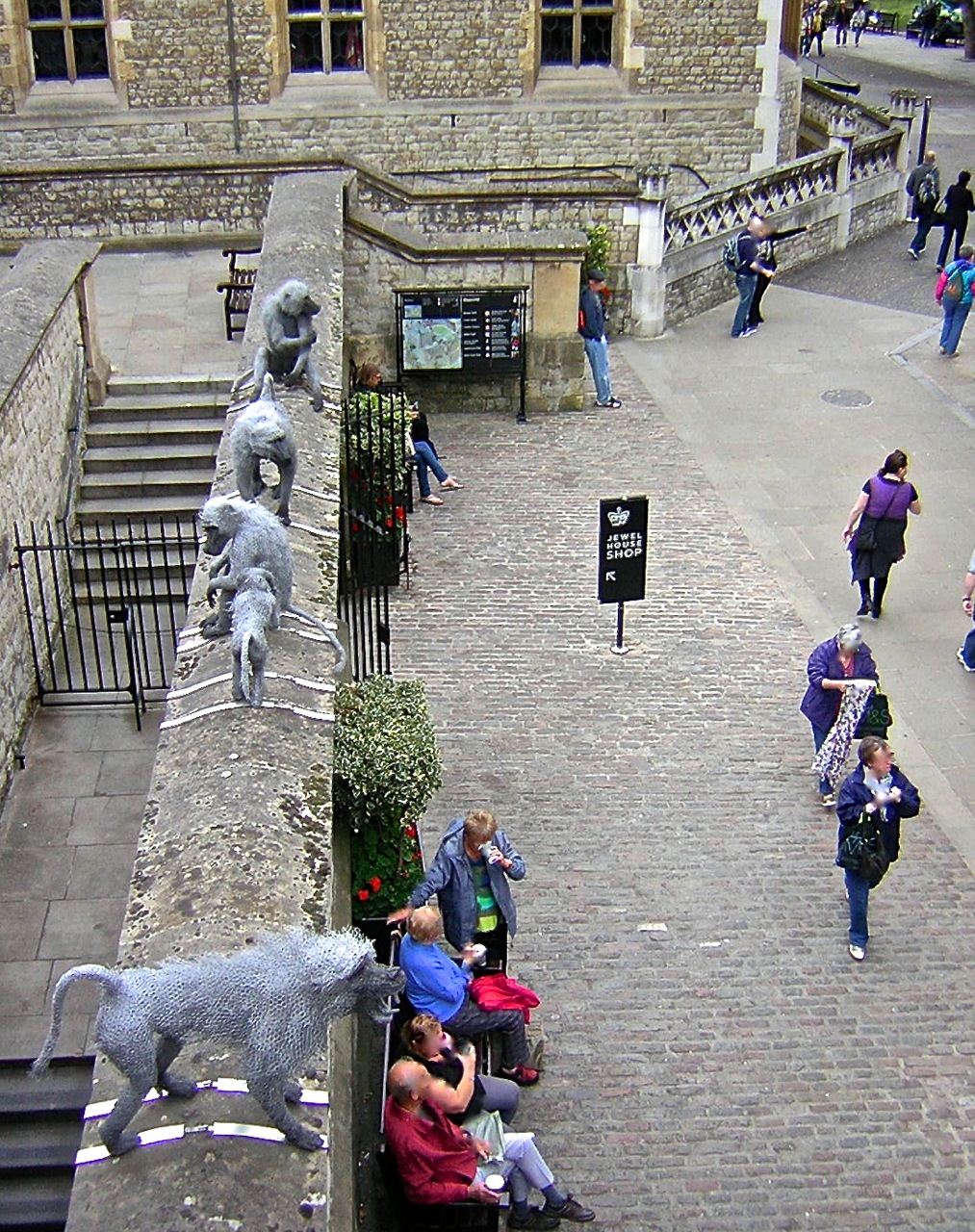
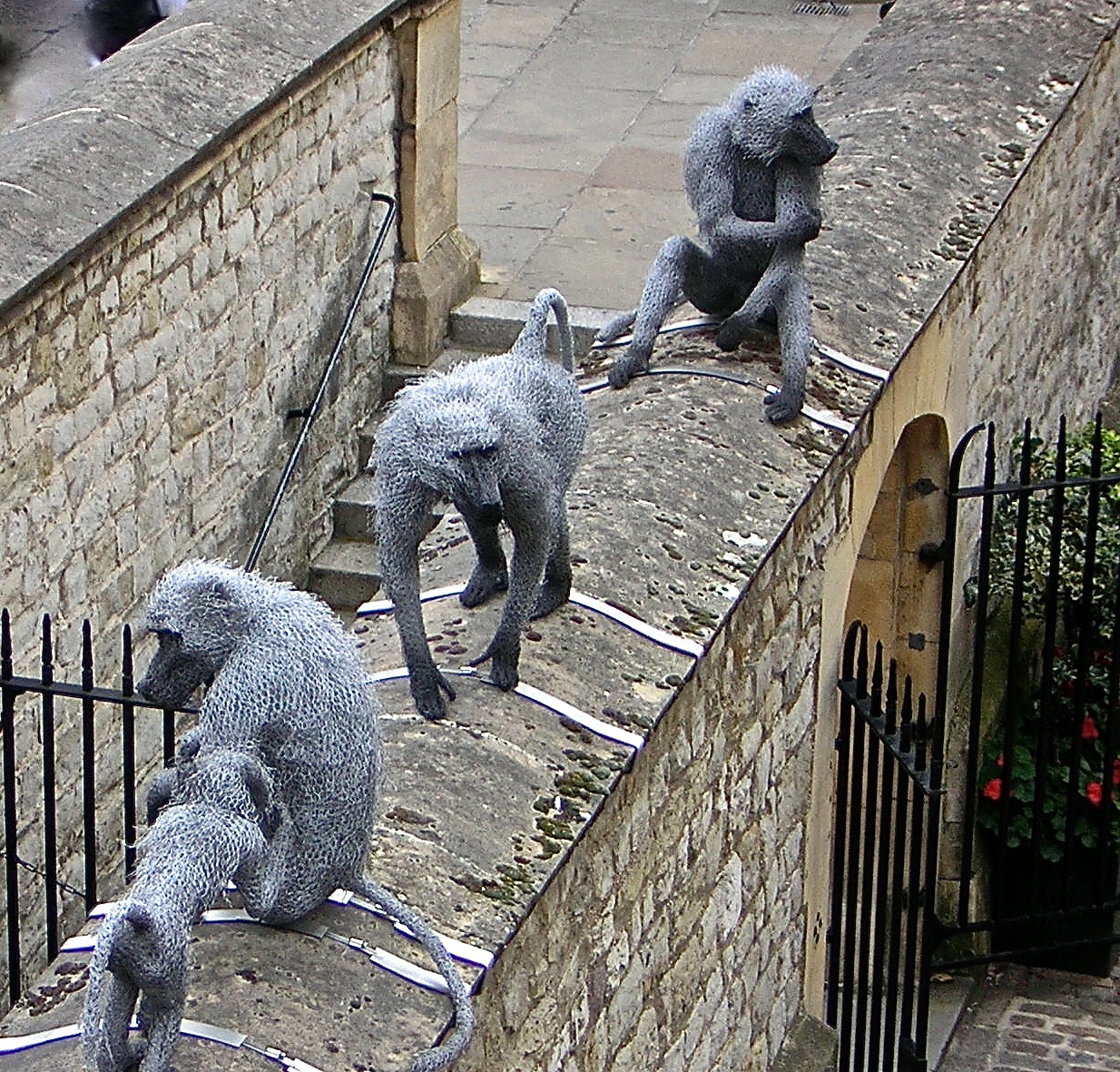
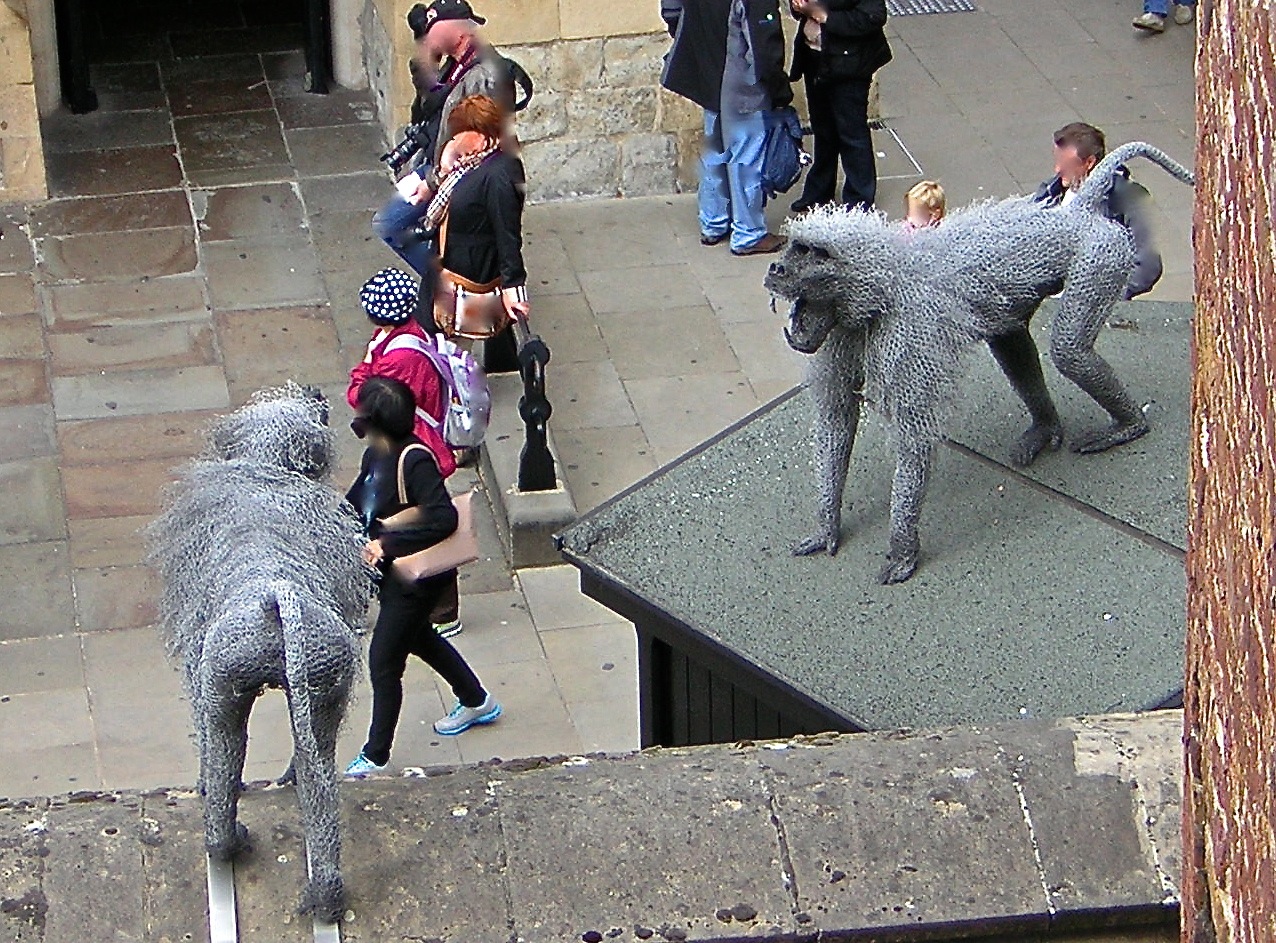
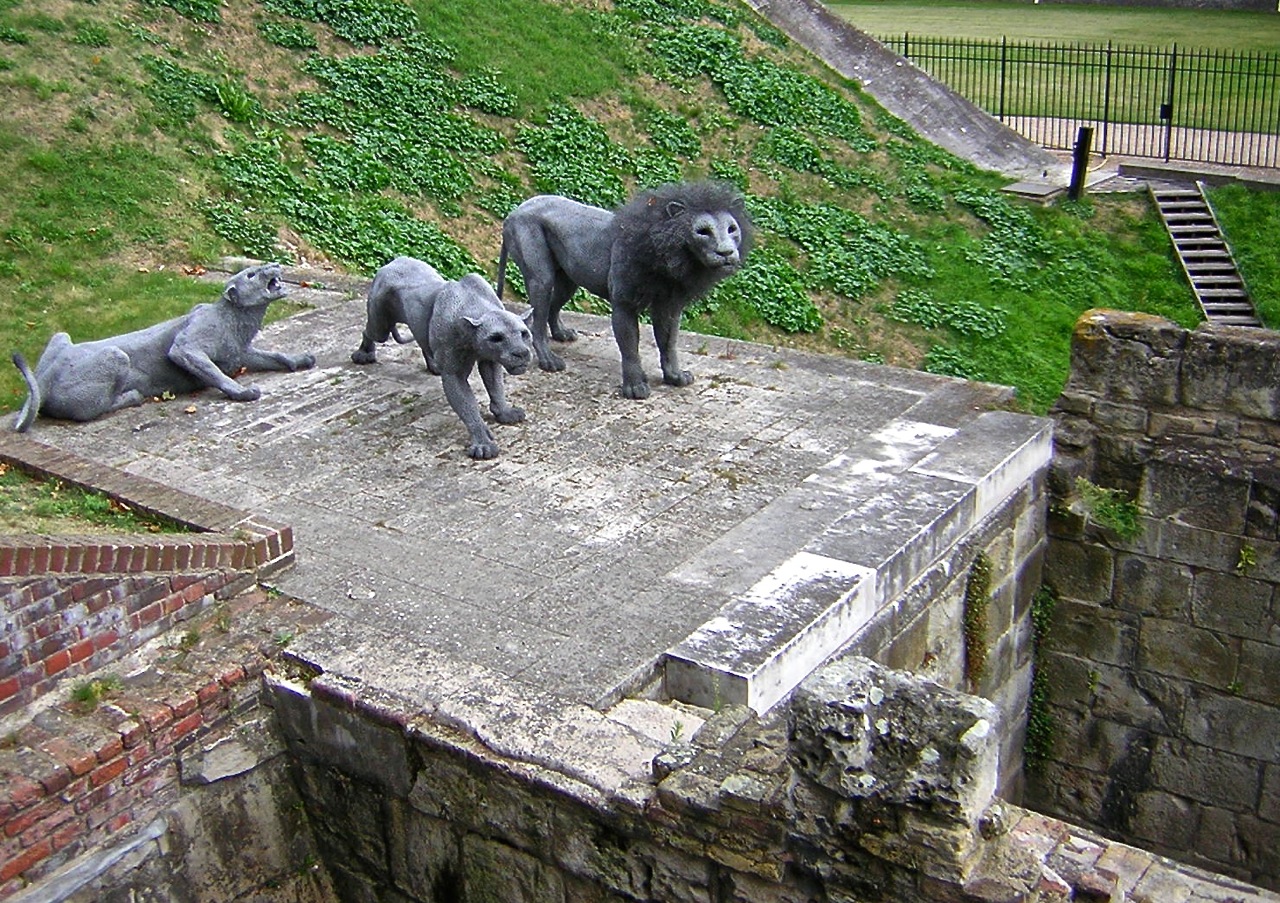
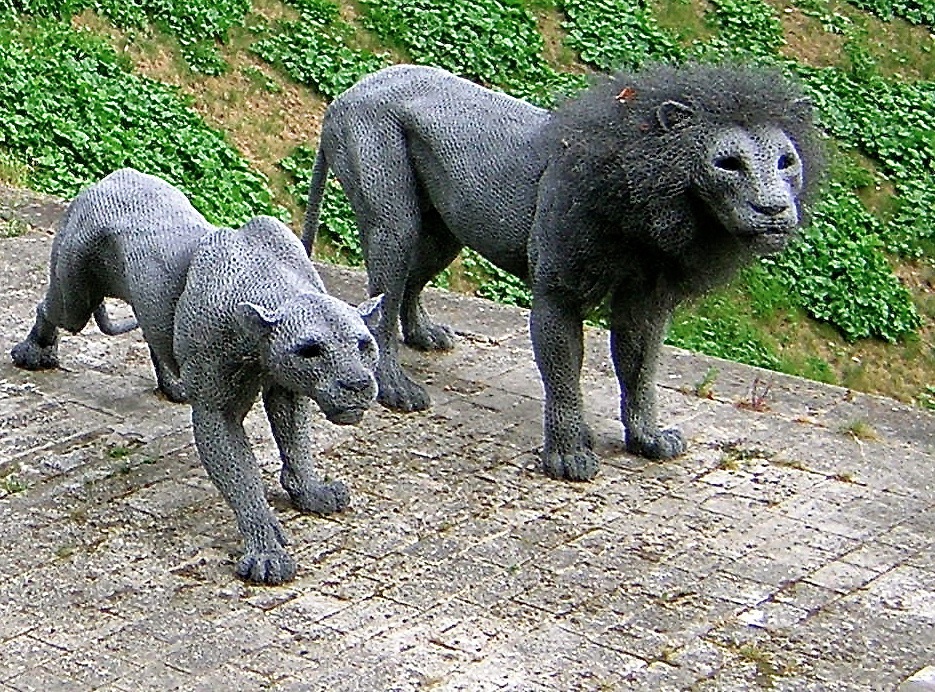
We visited the Tower of London during our September travels, and I really enjoyed these sculptures by artist Kendra Haste, representing the animals of the “Royal Menagerie,” who lived at the Tower for over 600 years.

The baboons, lions, elephant, and polar bear are remarkably life-like, especially considering that they are made out of chicken wire (with a steel armature within). Haste was commissioned to create the animals in 2010, and they were installed in 2011 as part of the Tower’s “Royal Beasts” exhibit. They will remain in place for 10 years.

There’s an interesting short video of Haste at work here.

The first animals at the Tower were lions (1210). An elephant arrived in 1255. In 1832, when attacks on visitors and staff could no longer be ignored, the animals were moved to the London Zoo.

Tavistock Square

Then one day walking round Tavistock Square I made up, as I sometimes make up my books, To the Lighthouse; in a great, apparently involuntary, rush.
— Virginia Woolf

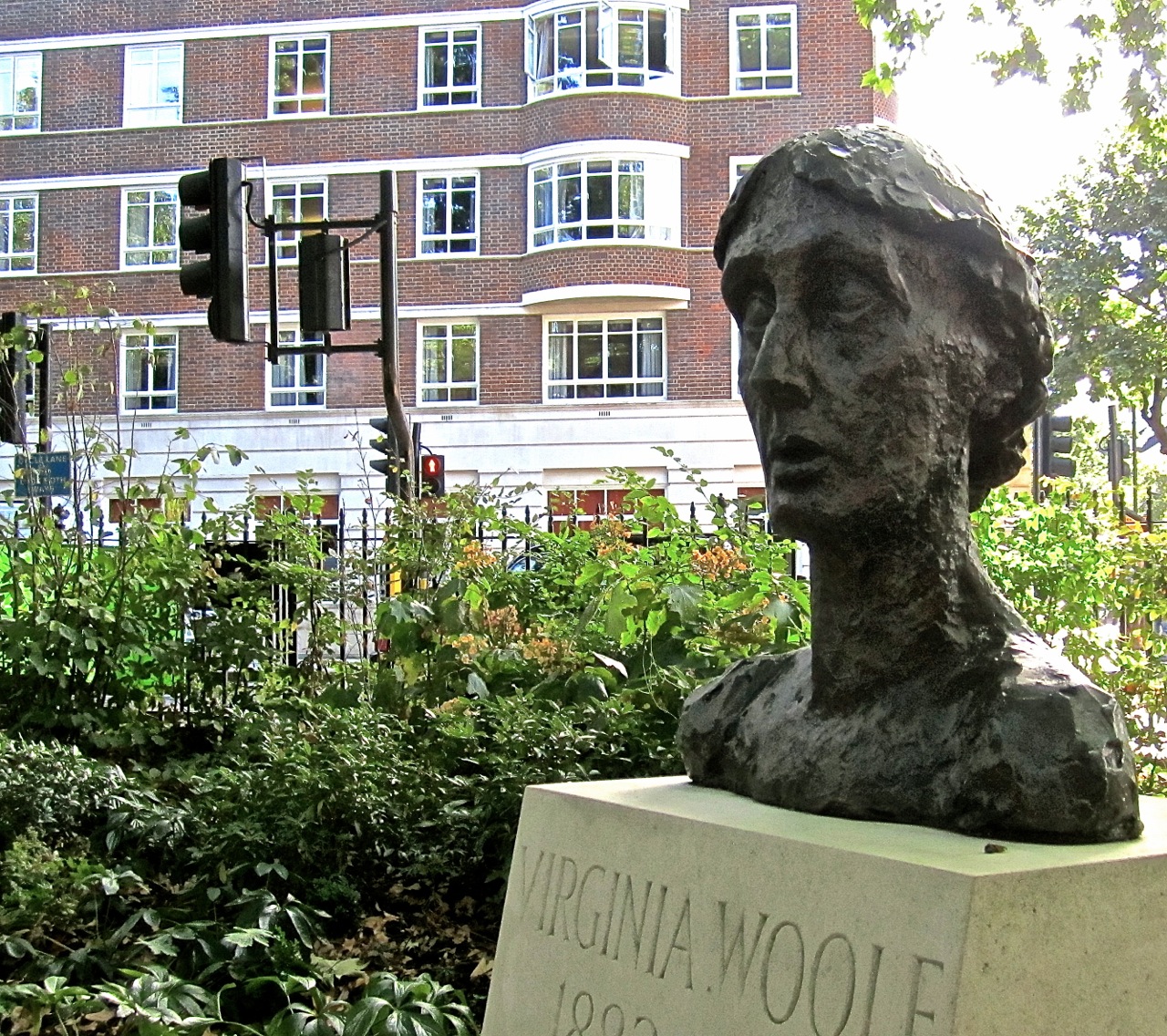
During our visit to London about a month ago, we stayed in a hotel in Bloomsbury, and on our last morning there, being a good former English major, I had to go looking for Virginia.

I found her small monument, inscribed with the above quote, in the south corner of Tavistock Square.  From 1924 to 1939, she and her husband lived in a house located on the site of the hotel that you can see behind her head in the photo above.

Leonard Woolf has his own memorial in the square: a Gingko biloba tree, planted in 2004 to mark his work as a colonial administrator in Sri Lanka.

Originally laid out about 1800, the square today is bordered by a wide path shaded by both tall and pollarded trees.  In the center of the park are flower beds and lawn, many benches, and a large sculpture.  It is conventional, but pretty, and a very nice place to stroll and think.

On the day when Virginia Woolf conceived her great book, only residents of the houses surrounding the square would have been able to enter its gates.  In an essay written during the hot summer of 1933, she approved “[t]he sensible and humane suggestion . . . that the squares should be opened … to those who would otherwise have no place to walk or sit but in the street.”

In 1940, Tavistock Square was temporarily opened to all when its iron fence was melted down for war use. (The park was officially opened to the public in the 1950s.)

The square is also associated with Charles Dickens, who lived in a house across from the north corner from 1851 to 1860. There, he wrote Bleak HouseHard TimesLittle Dorrit, and A Tale of Two Cities. The residence was demolished in 1901 and was replaced by an office building designed by Sir Edwin Lutyens. It is now the headquarters of the British Medical Association (BMA).

Lutyens also designed a large monument to Dame Louisa Aldrich-Blake, the first British woman to qualify as a surgeon, which was placed in the east corner in 1926.
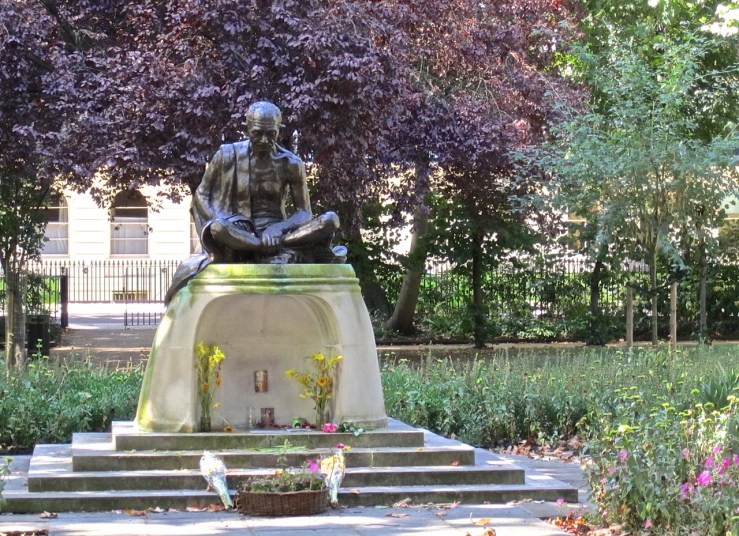
From the 1960s, Tavistock Square has been known for its various memorials to peace and non-violence, including

  • a sculpture of Mahatma Gandhi by Fredda Brilliant (shown above) (1968);
  • a cherry tree planted in memory of the victims of the nuclear bombing of Hiroshima (1967);
  • a maple tree planted by the League of Jewish Women in honor of the U.N.’s International Year of Peace (1986);
  • and the Conscientious Objectors Stone, installed by the Peace Pledge Union (1995).

Four of the park’s planting beds also honor memorial subjects  — two with plants from India and Japan, one with English shrubs for Woolf, and one with medicinal plants for Aldrich-Blake.

Several years ago, another memorial was added to the square, in the form of a small plaque affixed to the current iron fence. It marks the section of street in front of the BMA where the last of the four July 7, 2005, suicide bombers blew up the Number 30 double-decker city bus and killed thirteen of the fifty-two commuters who died that day.

Gordon Square

Most of the social and intellectual activity that we associate with the Bloomsbury Group took place about a block west of Tavistock Square in a row of houses on Gordon Square.
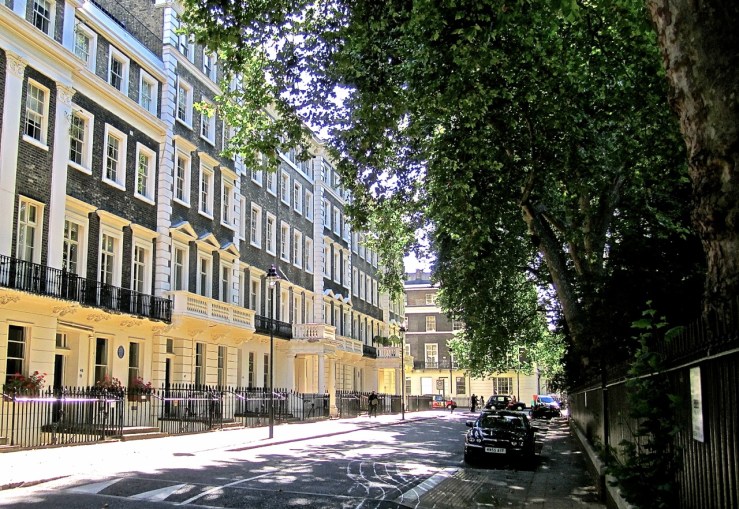
From 1904 to 1907, Virginia and Vanessa Stevens (later Woolf and Bell) lived in #46 Gordon Square with their brothers, Thoby and Adrian. The siblings held regular ‘at homes’ on Thursday and Friday evenings with such guests as Lytton Strachey, George Bernard Shaw, Maynard Keynes, E.M. Forester, Clive Bell, Duncan Grant, Roger Fry, and John Nash. (After their marriage, Vanessa and Bell took over the house from 1907 to 1916.)

From 1920 to 1925, Vanessa lived at #50 with her children and then at #39 with both her husband and lover Duncan Grant.  Strachey and other members of his family lived at #51 from 1919 to 1956.

In the photo above, #46 is the first house on the left side (with the oval plaque), four doors down is #50 and then #51.