Vintage landscape: the capitol and the conservatory

Botanical garden at the CapitalThe U.S. Botanic Garden, 1917, by Harris & Ewing, via Library of Congress Prints and Photographs Division.

The conservatory will be decorated for the holidays through January 5.

I wish you a very happy 2014.

“. . . Botanic Goddess! bend thy radiant eyes;
O’er these soft scenes assume thy gentle reign,
Pomona, Ceres, Flora in thy train;
O’er the still dawn thy placid smile effuse,
And with thy silver sandals print the dews;
In noon’s bright blaze thy vermil vest unfold,
And wave thy emerald banner starr’d with gold.”

Thus spoke the Genius, as he stepp’d along,
And bade these lawns to Peace and Truth belong;
Down the steep slopes he led with modest skill;
The willing pathway, and the truant rill,
Stretch’d o’er the marshy vale yon willowy mound,
Where shines the lake amid the tufted ground,
Raised the young woodland, smooth’d the wavy green,
And gave to Beauty all the quiet scene.—

Erasmus Darwin, from  “The Botanic Garden”

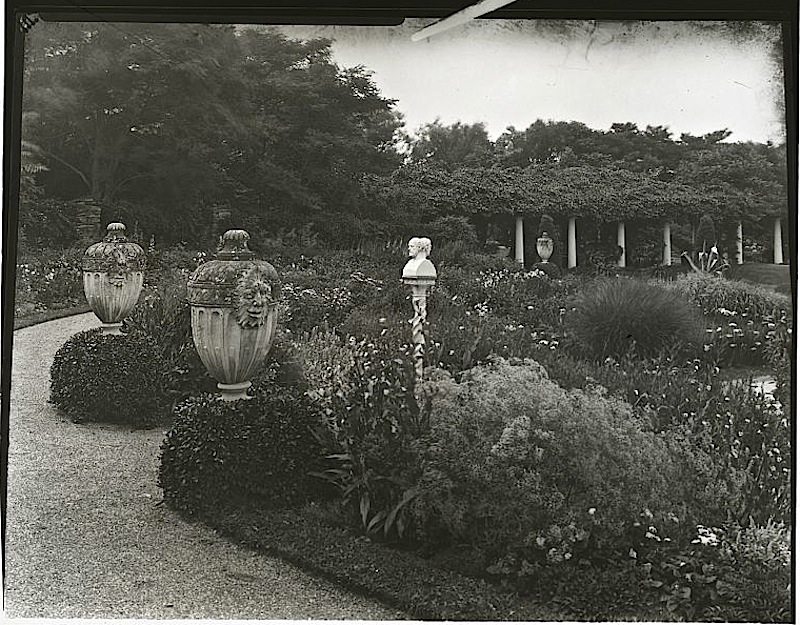
Vintage landscape: the sunken garden

Vintage landscape/enclos*ure: sunken garden, Hammersmith Farm, 1917, by F.B. Johnston, via Library of Congress. . . at Hammersmith Farm, Newport, Rhode Island, 1917, by Frances Benjamin Johnston, via Library of Congress Prints and Photographs Division.

Vintage landscape/enclos*ure: sunken garden, Hammersmith Farm, 1917, by F.B. Johnston, via Library of CongressThe pergola overlooking the sunken garden. The hand-colored lantern slide is also by Johnston from 1917.

The house, originally on 75 acres, was built for the great-grandfather of Jackie Kennedy’s stepfather.  She lived there during her childhood, and her wedding reception was held there.

The garden at the time of the photo had been designed about 7 years before by James Frederick Dawson and Henry Hill Blossom of Olmsted Brothers. Today, the house still stands, but the garden is not the same, according to the Library’s online catalogue.

Vintage landscape: garden of the mind

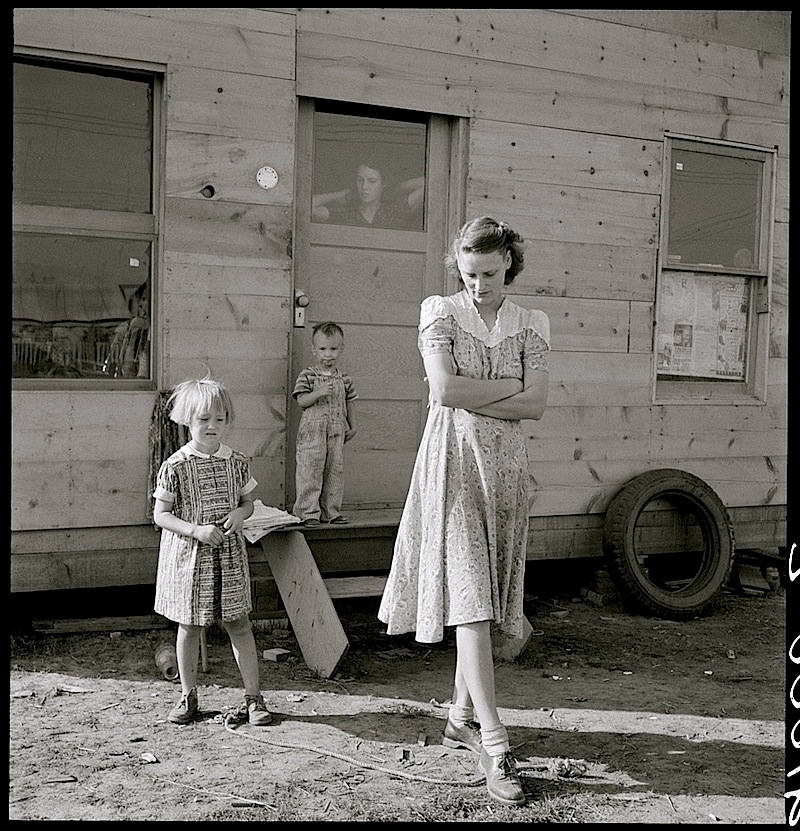
Young mother in squatter camp dreams of a garden, Sept. 1939, by Dorothea Lange, via Library of Congress“Young mother, twenty-five, says, ‘Next year we’ll be painted and have a lawn and flowers,’ rural shacktown, near Klamath Falls, Oregon,” September 1939.

Photo and caption by Dorothea Lange for the U.S. Farm Security Administration, via Library of Congress Prints and Photographs Division.

‘Established’ is a good word, much used in garden books,
‘The plant, when established’. . .
Oh, become established quickly, quickly, garden!
For I am fugitive, I am very fugitive —

Mary Ursula Bethell, from “Time

Vintage landscape: two trees

Vintage landscape: Bartram's old tree, c. 1908, Philadelphia, Pa./enclos*ure“Old tree in Bartram’s Park [sic], Philadelphia, Pa.,”  by Detroit Publishing Co. via Library of Congress Prints and Photographs Division.

I can’t find out why this apparently dead tree was fenced off so nicely in Bartram’s Garden in about 1908.  Does anyone know?

Bartram’s is the oldest surviving botanic garden in North America.  It was founded in 1728 and became a city park in 1891.

This photo made me think of the Tree of Ténéré, an acacia that was famous for being the only tree for 250 miles on the cavavan routes through the Sahara Desert in northeast Niger.  In 1973, a drunk truck driver managed to knock it down.

Arbre-du-tenere-1961
The tree in 1961. Photo by Michel Majeau, via Wikimedia Commons.

The dead tree was moved to the National Museum of Niger in Niamey later that year — where it was given its own pavilion.  I saw it there several years ago.

The trunks of the fallen tree in its pavilion in the museum in 1985. Photo by Holger Reineccius, via Wikimedia Commons.
The tree at the museum in 1985. Photo by Holger Reineccius, via Wikimedia Commons.

A metal sculpture of the tree was erected at its old location.   (There are more photos  here.)

One must see the Tree [of Ténéré] to believe its existence. What is its secret? How can it still be living in spite of the multitudes of camels which trample at its sides. How at each azalai does not a lost camel eat its leaves and thorns? Why don’t the numerous Touareg leading the salt caravans cut its branches to make fires to brew their tea? The only answer is that the tree is taboo and considered as such by the caravaniers. . . .  The Acacia has become a living lighthouse; it is the first or the last landmark for the azalai leaving Agadez for Bilma, or returning.

— Michel Lesourd, Commander of the Allied Military Mission of the Central Service of Saharan Affairs after he saw the tree in 1939

Vintage landscape: California living

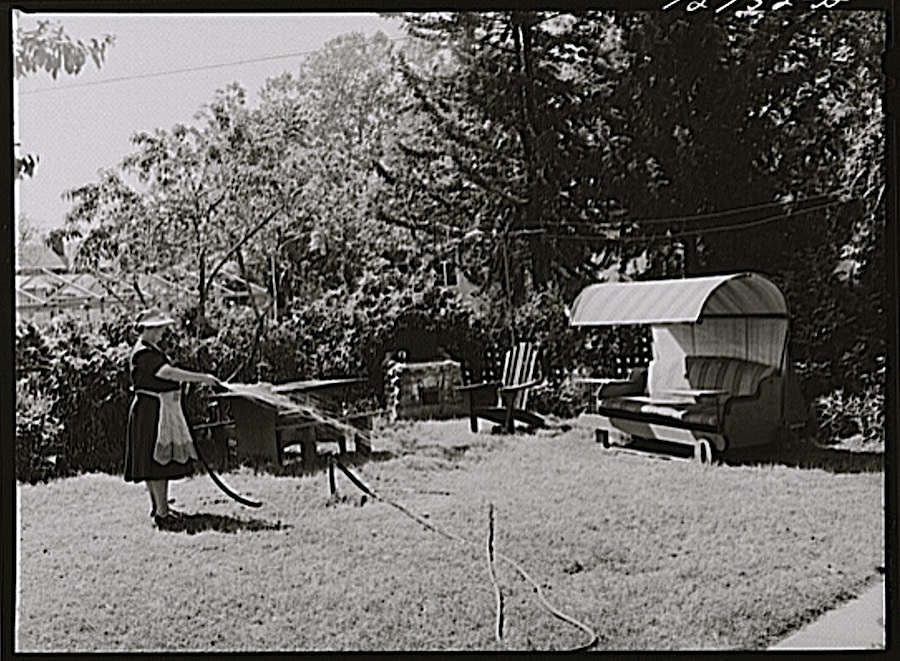
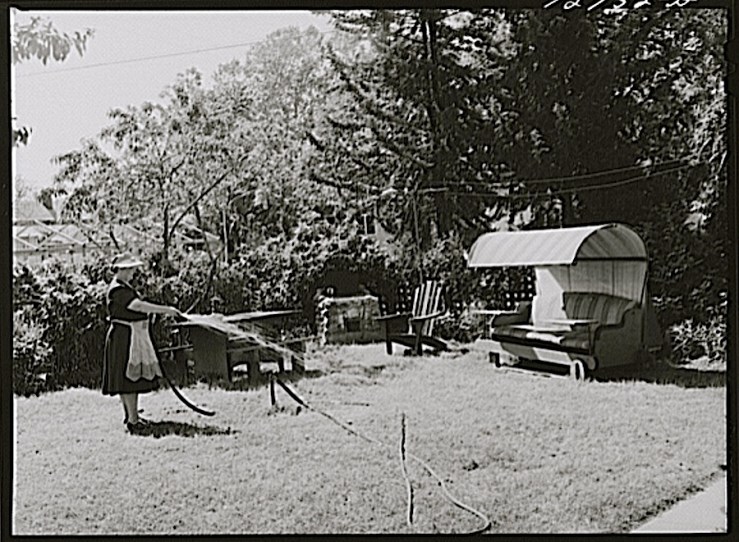
Back yard, Turlock, CA, 1943, by Russell Lee, Library of Congress

I just like this life-in-the-garden photo by Russell Lee, * of a (May) 1942 Turlock, California, backyard.  (Unfortunately, it’s not very sharply focused.)  The caption, possibly by the photographer, reads:

Housewife waters the lawn. All garden furniture and barbecue pit were made by her husband; about one out of every three houses in this town has such an arrangement in the backyard, and during the summer months people eat and spend many hours in their yards.

I particularly like the rolling sofa thing with the awning.  Turlock is located in central California between Modesto and Merced.

Lee was working for the Farm Security Administration/Office of War Information at the time.  He seems to have been sent to Turlock to photograph townfolks being resilient in the face of changes brought on by the war.  He took a number of photographs of this family, described in the Library of Congress online catalogue as from the “upper middle income group.”
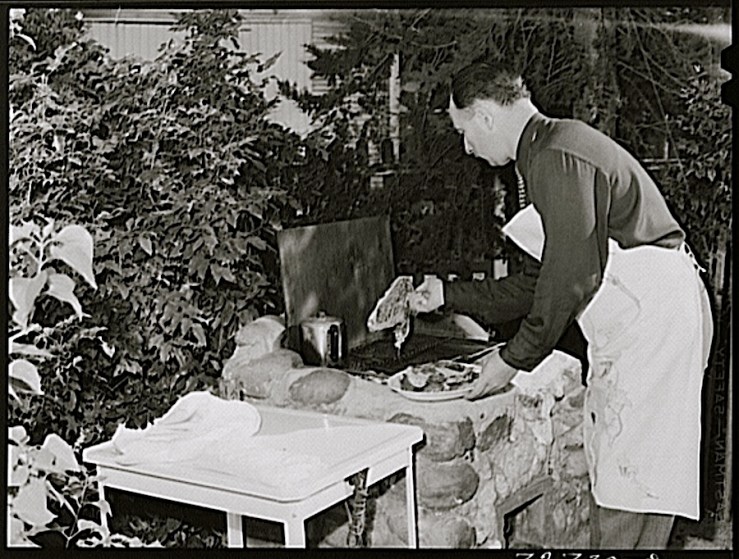
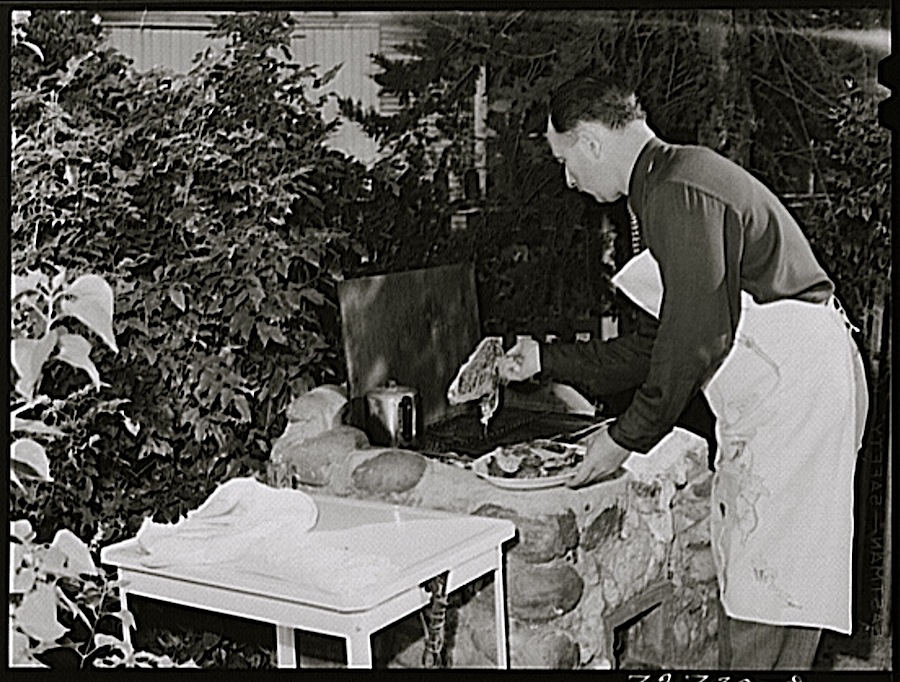
Grillling steaks, Turlock, CA, 1943, by Russell Lee, Library of CongressAbove: “Man of the house barbecues steaks over open grill in his backyard. This family keeps vegetables, fruits and meats in frozen food lockers in town.”
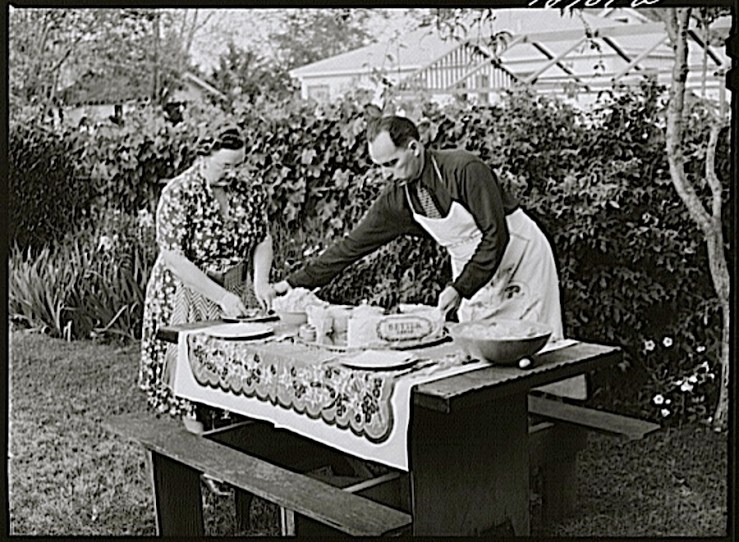
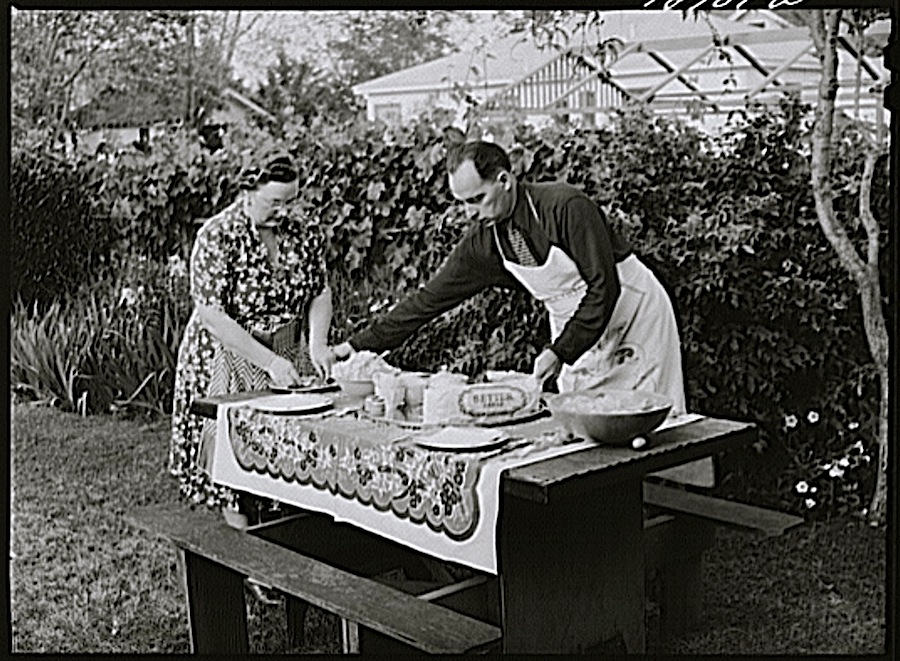
Setting the table, Turlock, CA, 1943, by Russell Lee, Library of CongressAbove: “Husband and wife get ready for dinner in their backyard. Menu: barbecued steaks, fresh peas, potato salad, potato chips, celery and olives, strawberry shortcake, and coffee.”

The package around the loaf of bread says, “Better Bread.”  Over the hedge, the neighbors seem to be putting in a greenhouse.
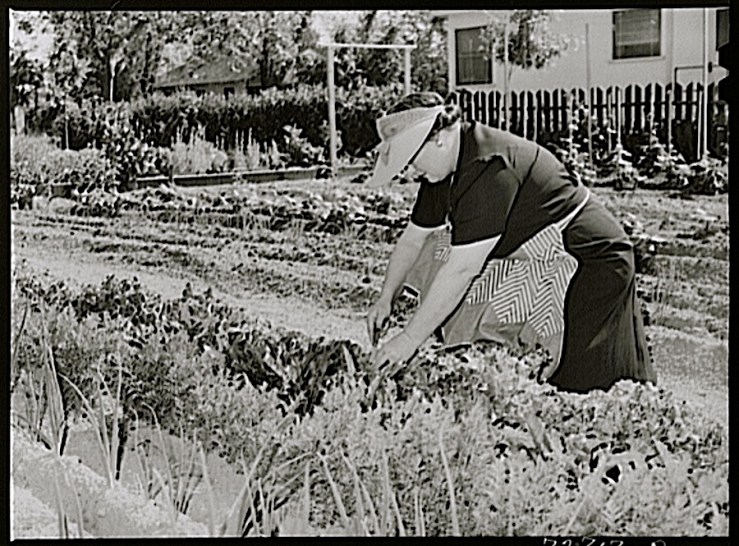
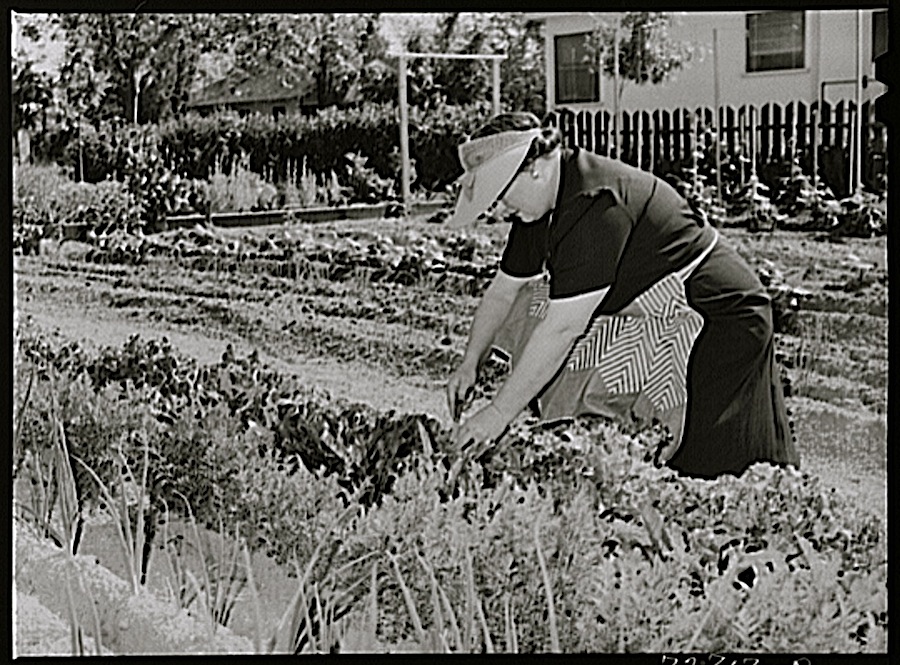
Tending the garden, Turlock, CA, 1943, by Russell Lee, Library of CongressAbove: “Housewife works in her vegetable garden. She lives in small town where there is ample space for gardens; says she would move to country if she couldn’t have a garden in town.”

It’s quite impressive — and particularly that she works it in a dress.  Here’s another view, below:
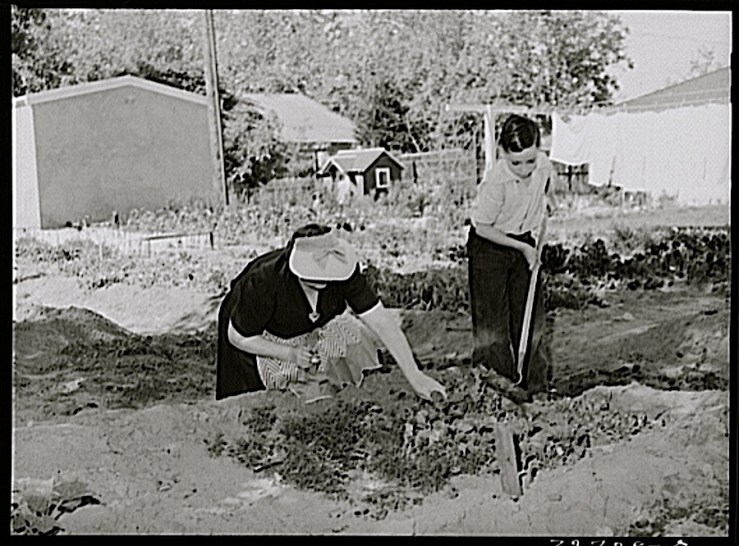
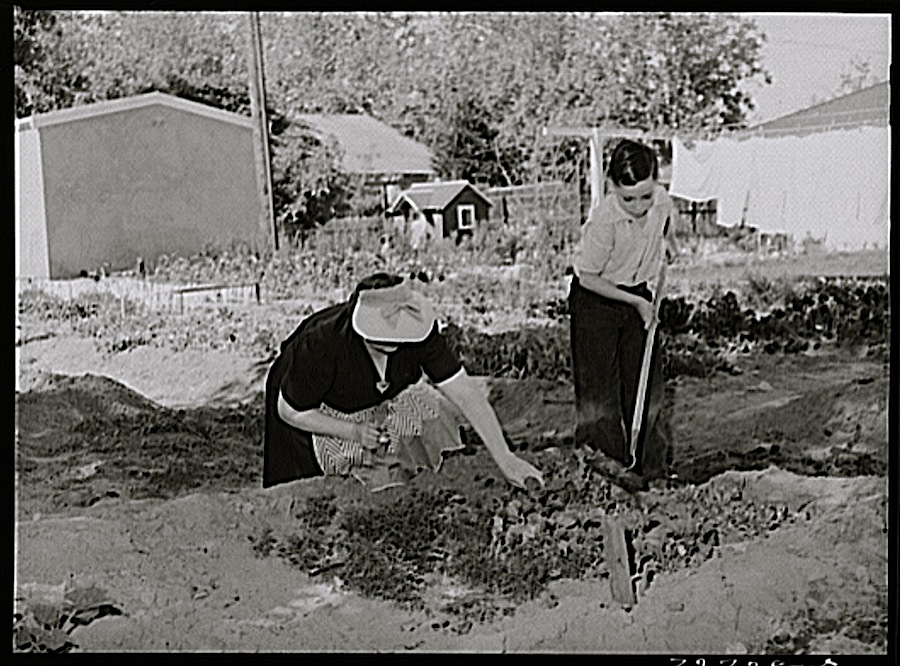
Son's garden, Turlock, CA, 1943, by Russell Lee, Library of CongressAbove: “Housewife helps her son with his garden.”
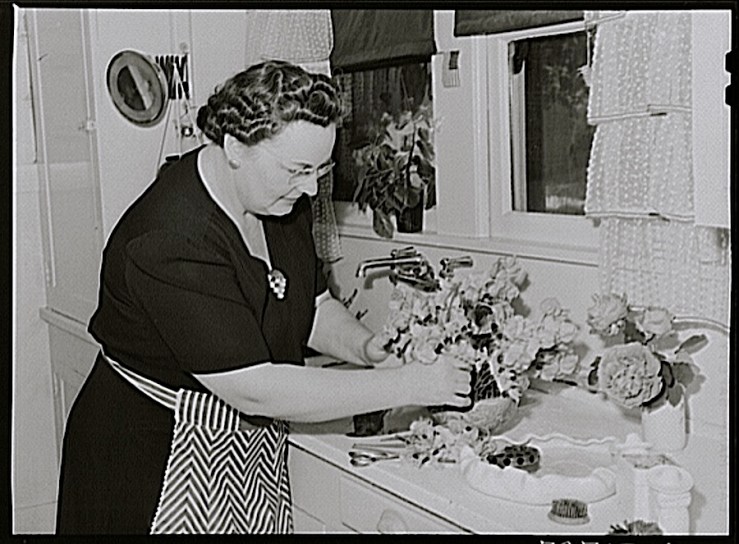
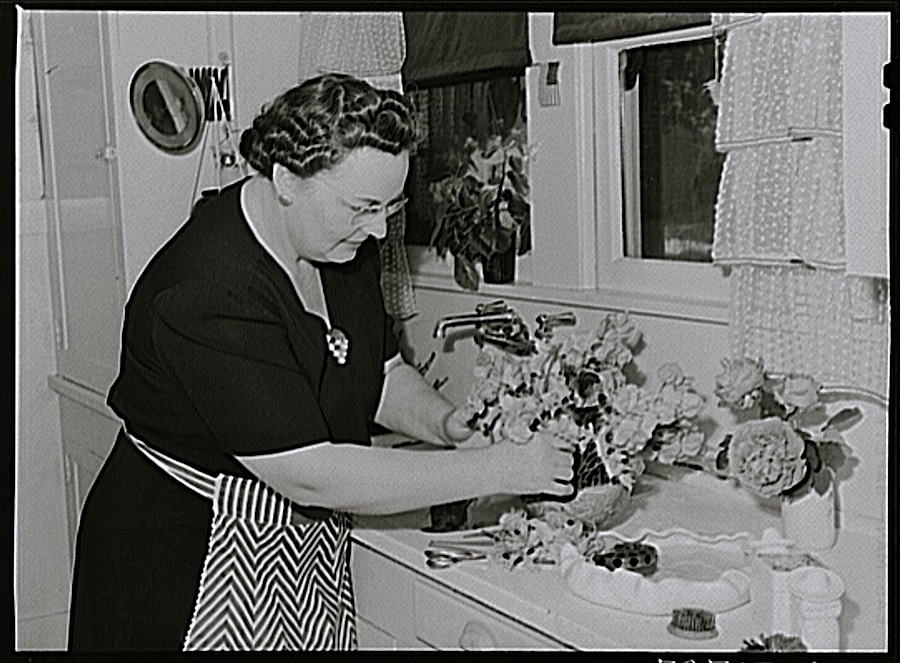
Arranging flowers, Turlock, CA, 1942, by Russell Lee, Library of CongressAbove: “Housewife arranging flowers in her kitchen.”

I like her dotted swiss curtains.

I’m going to take a break from blogging for a few weeks (except for “The Sunday porch”), but I’ll be back for GB Bloom Day in October.


* All photos here via Library of Congress Prints and Photographs Division.