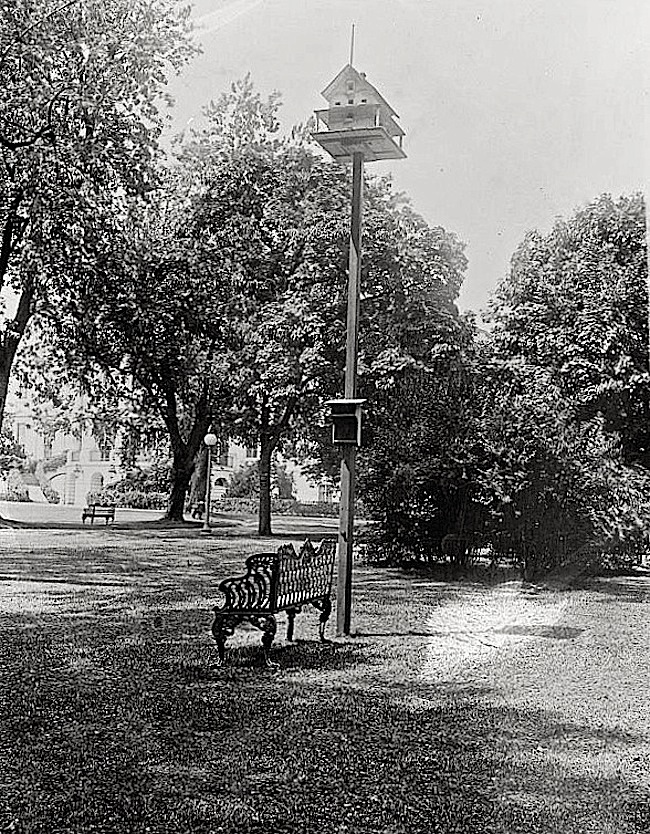
 “One of the many bird houses which Mrs. [Warren G.] Harding has installed in the White House grounds,” between 1921 and 1923, by National Photo Company, via Library of Congress Prints and Photographs Division.
First Lady Florence Harding was a great advocate for better animal care and protection. In addition to the birdhouses, she also had squirrel huts placed around the gardens — and had the animal trophy heads removed from the State Dining Room, according to her biographer Carl Anthony.
Early changes to the residence’s outdoor space were part of the Harding Administration’s determination to banish the “gloom” of the war years under President Wilson, wrote John A. Morello in Selling the President, 1920. “More bulbs and flowers would be planted, and birdhouses were installed in trees.”
At least some of the official birdhouses came from Evans Brothers, “Manufacturers of Bird House and Lawn Accessories,” on Main Street in Evanston, Illinois.
A tiny article in the August 18, 1921, Chicago Tribune says, “Sparrows, robins, and other birds who are flat hunting at present may be interested to know that Conroy Evans. . . has just received an order from Mrs. Warren G. Harding for several bird houses to grace the White House grounds. . . and that Mrs. Harding will supervise the placing of the houses in trees.”
Conroy Evans contributed brief reports on the movements of Evanston birds to Bird Life magazine. In its fall issue of 1919, Evans Brothers also placed a small ad: “Who’s the ‘Mr. Hoover’ for the Birds? Why Evans Bros. of course.”
From 1917 to 1919, Herbert Hoover (later President Hoover) became well-known for his work on food relief for Europe as head of the U.S. Food Administration and then of the American Relief Association.

 House of Rousseau, Les Charmettes, in Chambéry, France, between ca. 1890 and ca. 1900, a photochrom by Detroit Publishing Co., via Library of Congress Prints and Photographs Division.


 enclos*ure