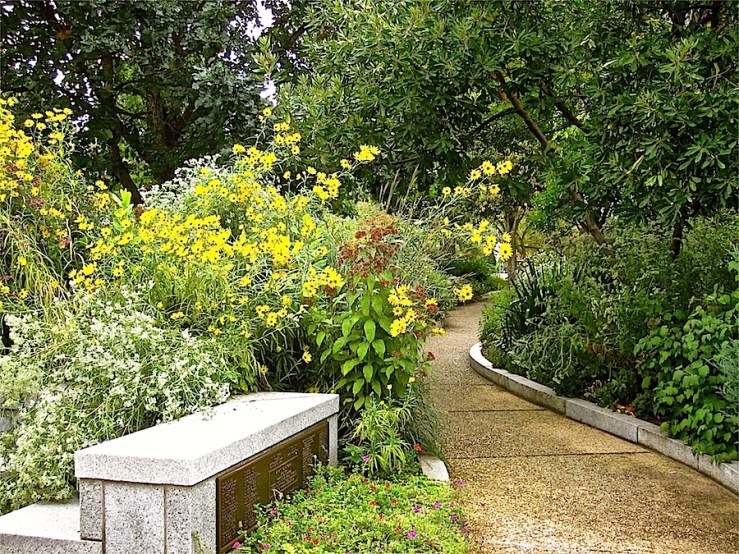
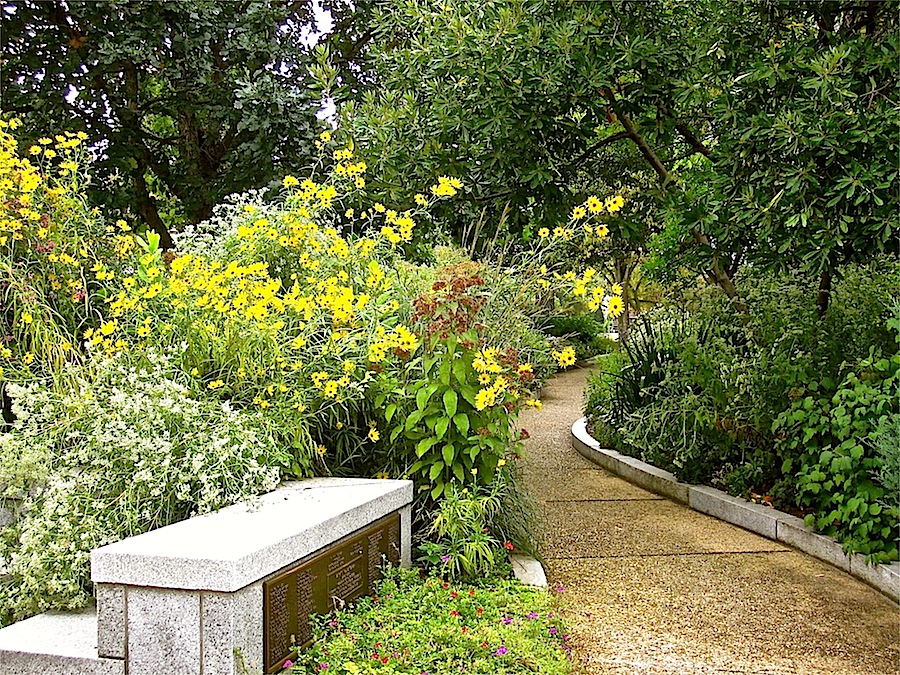
I’m sorry that these photos are a little out of season, but I enjoyed my late September visit to the Smithsonian Institution’s Butterfly Habitat Garden so much that I still wanted to share them.
The garden is a long corridor between the National Mall and Independence Avenue. It’s bordered by very busy 9th Street, N.W., on one side and the parking lot of the National Museum of Natural History on the other.
Stepping inside, however, you feel enveloped in another world — particularly in early fall, when many of the plants are at their fullest and tallest.

The entrance on the National Mall.

I really like the simple hardscaping.

Exposed aggregate concrete and white granite.

At the end of September, parts of the garden . . .

were absolutely frothy.

The plants have specific relationships to the life cycles of eastern U.S. butterflies.

Seedheads of ironweed.

Perennial sunflowers ‘Lemon Queen’ on the left.

The garden sections mimic habitats important to the insects:

. . . wetlands, meadows, edges of woods, urban gardens.

Can anyone identify this plant?

These are its seedpods.

“Golden Fleece’ goldenrod and ferns.

Begonia flowers and violets.

Looking toward Independence Avenue.

The National Archives in the background.

Update: the mystery plant above is Asclepias fruticosa (syn. Gomphocarpus fruticosus) from South Africa.

Walking back toward the Mall.
Click on any thumbnail in the gallery above to enlarge the photos.
In my captions, I haven’t included many plant labels, because I didn’t take very good notes during my visit. I was depending on a list of plants at the S.I. gardens website, but, unfortunately, it seems to have been removed for the moment. However, there are some recommendations in this Smithsonian brochure, and there’s additional information here at the Smithsonian gardens blog.
To see the garden in early August in 2011, click here.
ADDENDUM: The power of Pinterest — the mystery plant with the spiny seedpods is Asclepias fruticosa (syn. Gomphocarpus fruticosus), a species of milkweed native to South Africa. Thanks to Miranda M.

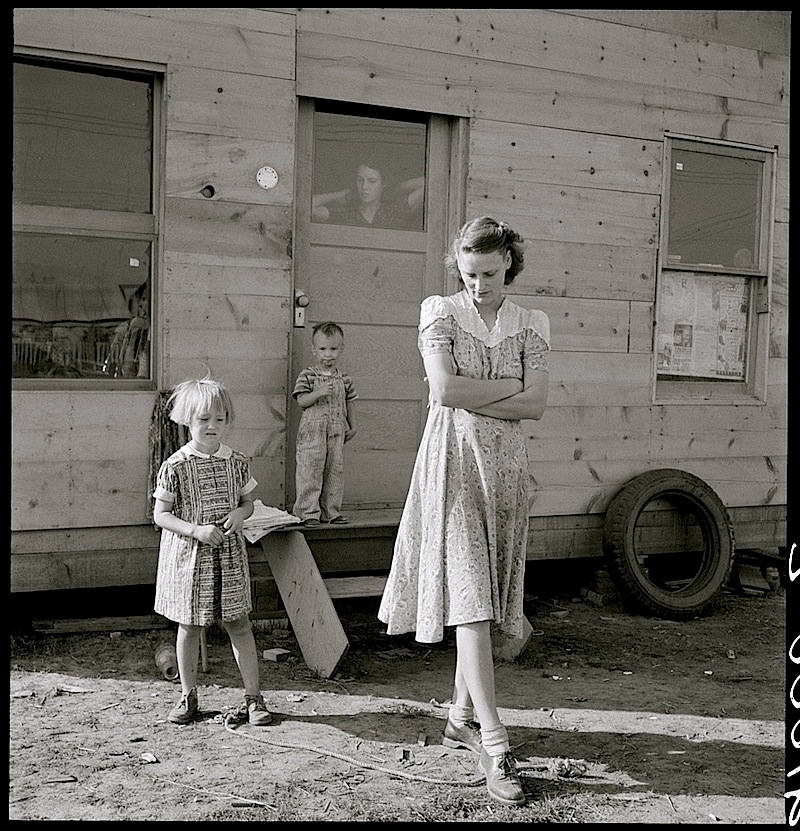 “Young mother, twenty-five, says, ‘Next year we’ll be painted and have a lawn and flowers,’ rural shacktown, near Klamath Falls, Oregon,” September 1939.


 enclos*ure