Kwita Izina

I know I promised news of our garden renovation for my next post, but I didn’t want to wait too long before sharing my photos of the baby gorilla naming ceremony on Saturday in Kinigi-Musanze in the north of Rwanda.

The Rwanda Development Board has been holding a naming ceremony (Kwita Izina) for each year’s babies since 2005 to raise awareness of conservation in the Volcanoes National Park and to highlight the work of the various Rwandan tourism enterprises.

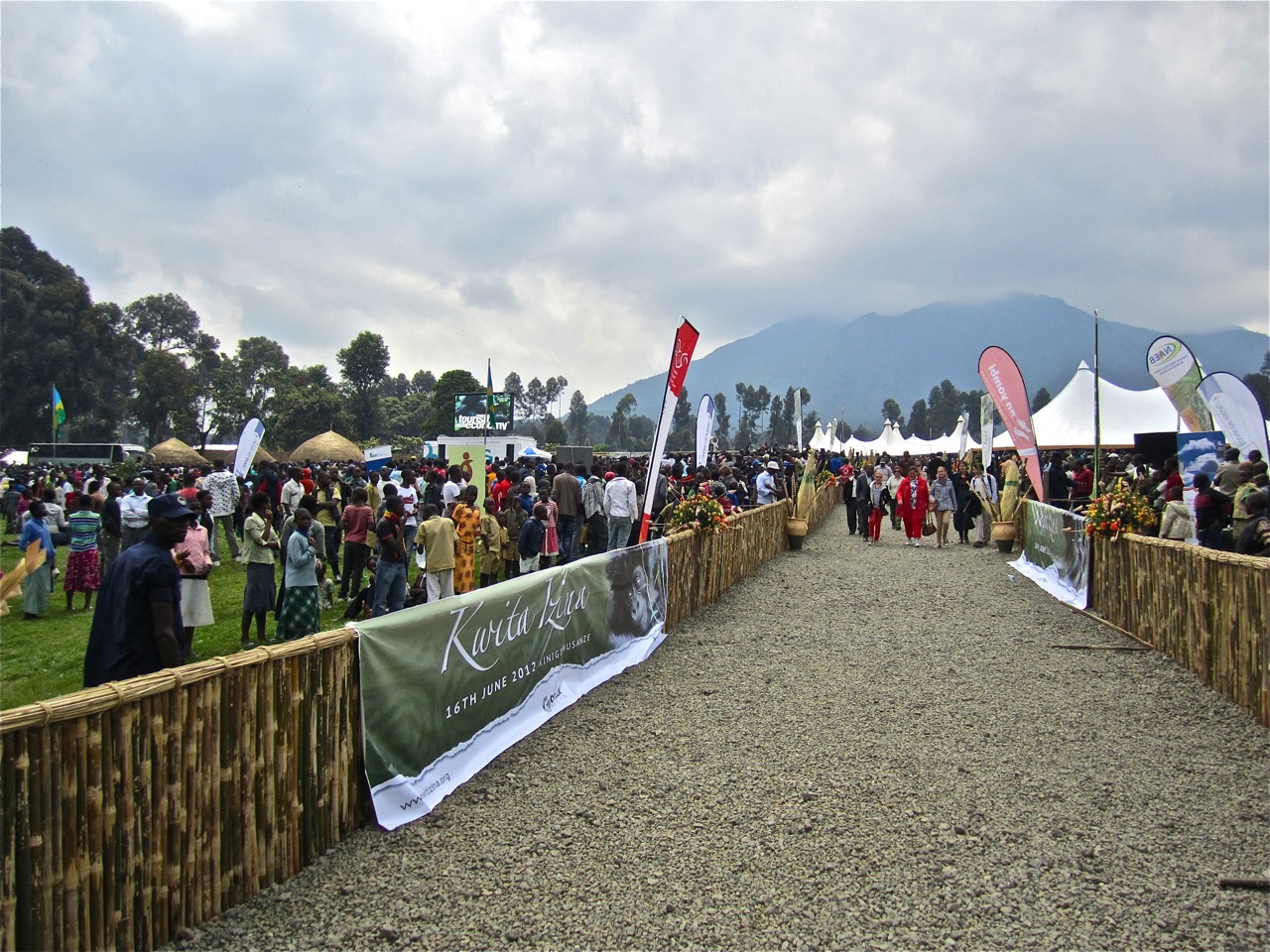
Banana stalks are traditionally used to mark the way to an important event. On Saturday, there were banana stalks staked up on both sides of the road from Kigali to Kinigi-Musanze (a 2-hour drive) about every 25 yards.
The tents and banners of the event. Unfortunately, the sky stayed overcast so we never really got a good view of the volcanoes.

Unfortunately, good animal conservation practices did not allow for the actual presence at the ceremony of this year’s 20 babies. But we had a card with their pictures, their mothers’ names, and a place to write their new names as they were called out.  You can ooh and aah over more of their really cute pictures at this link.

This baby’s mother is Nchili, and he likes kissing. Photo via kwitizina.org.
This baby’s mother is Rwandrushya. According to http://www.kwitizina.org, he has already challenged the silverback of his group.

However, we did have a fun bit of theatrics with 2o children costumed as gorillas.

The “baby gorillas” arrive.  Click the photos to enlarge them.
The “baby gorillas” cavort for the crowd as their park ranger observers take note.

They did a really good job of mimicking the movements of real young gorillas, and they were even accompanied by observers taking notes.  However, the masks were maybe a little too toothy.

The baby gorillas pose for the press.

We had a great morning, although it was quite cold — next year I will bring a blanket — and it was too overcast to see the volcanoes’ peaks.

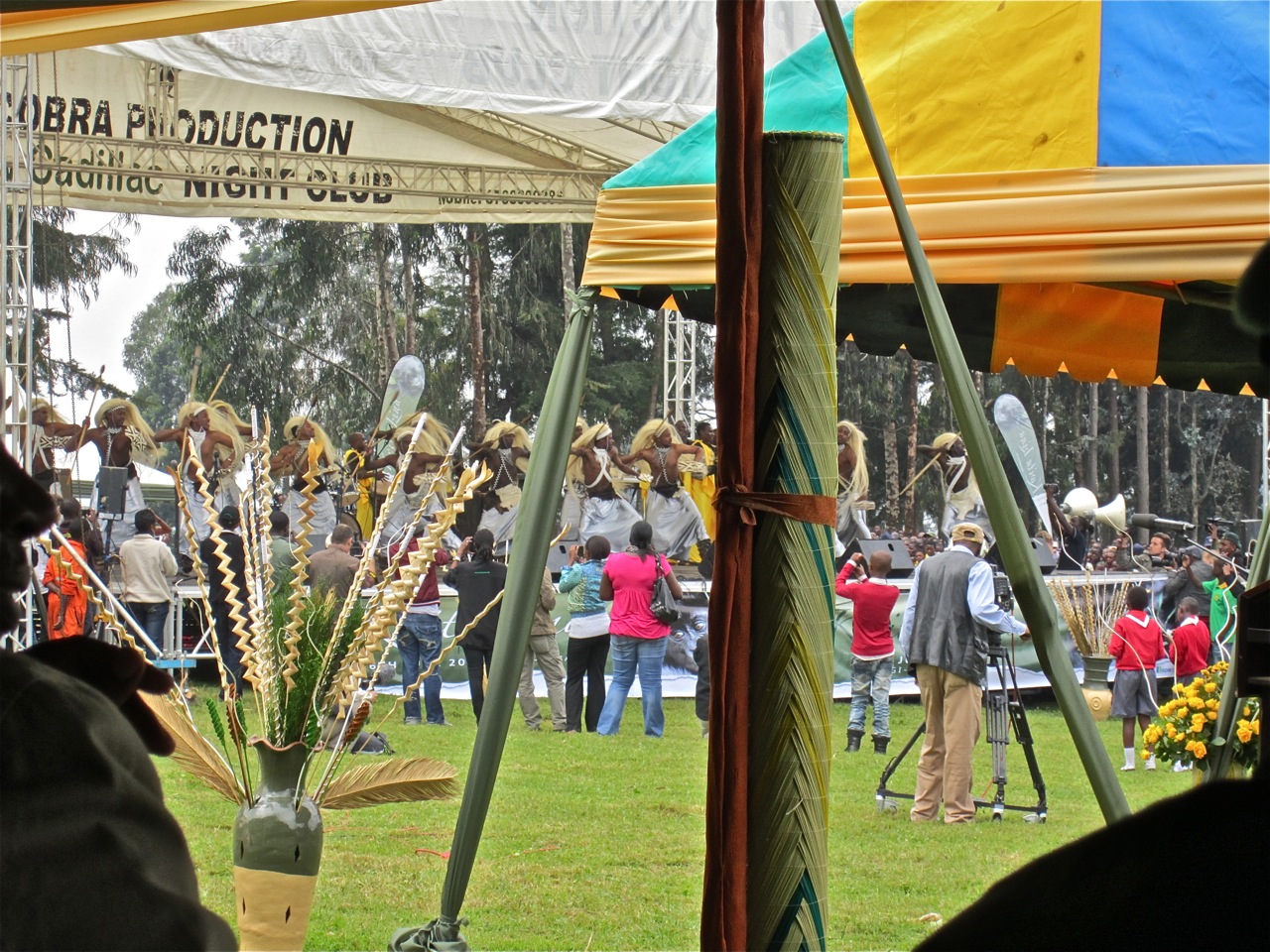
A Rwandan drumming group entertains before the naming ceremony.
They were followed on the stage by traditional Intore dancers.
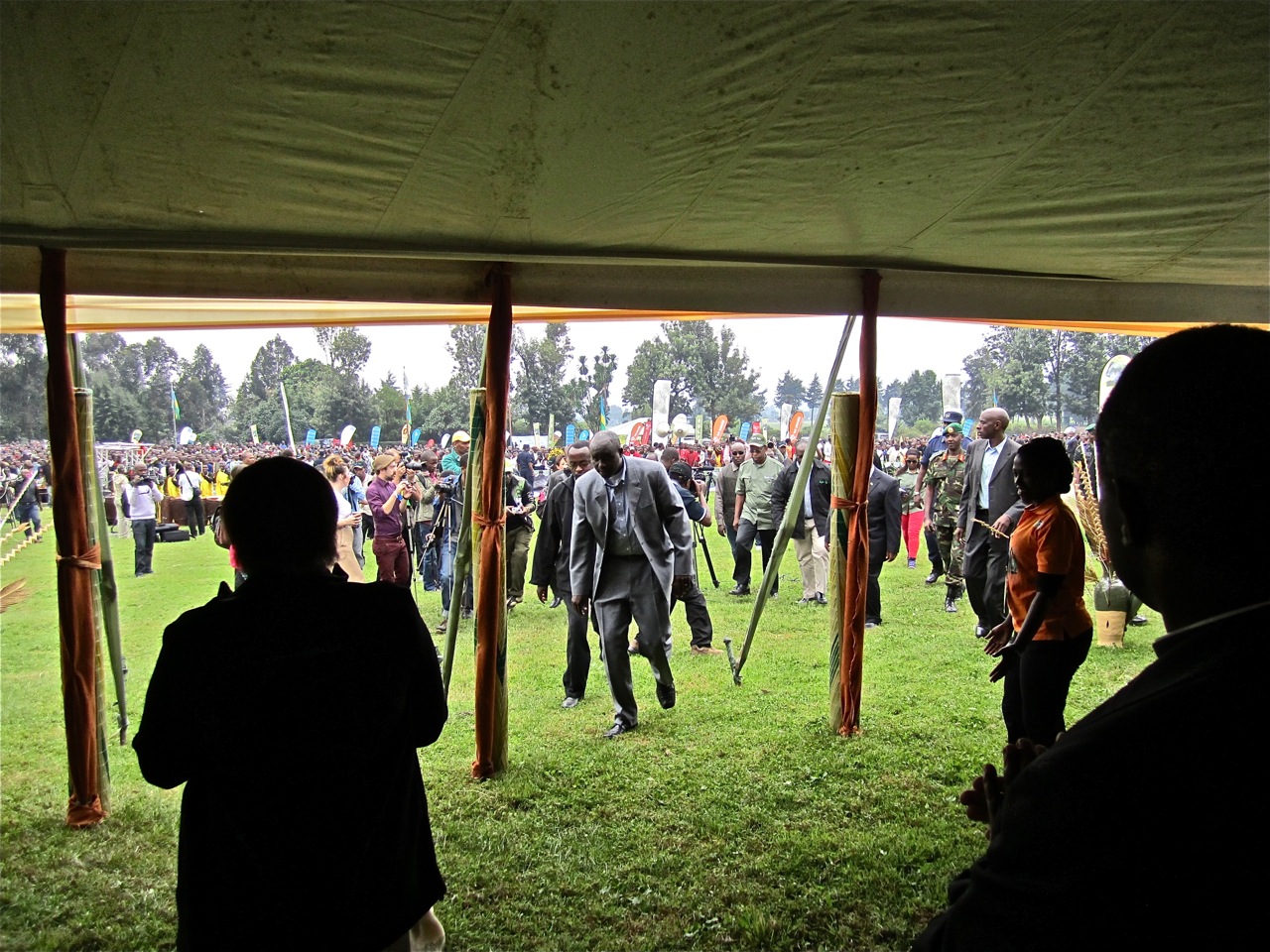
The arrival of the Prime Minister. Unfortunately, the rumor that Robert DeNiro was coming to the ceremony turned out to be untrue.
The baby gorillas onstage as the Mayor of Musanze announces a baby’s name.
A faint glimpse of a volcano peak behind the tents.

Gorilla tourism in Rwanda has contributed to a 26.3% growth in the mountain gorilla population since the last census in 2003.  Tourism brought US$200 million in revenues to Rwanda in 2010.

Wordless Wednesday: the Jordan River

Hand-colored photographs by the American Colony of Jerusalem taken between 1900 and 1946, showing the Jordan River, olive trees, and “Bethlehem, Juda, and Blue Galilee.”

All photos via the Matson Collection of the Library of Congress.

Vintage landscape: Gethsemane

I’ll take one more pass at the interesting photographs of the Library of Congress Matson Collection  (American Colony of Jerusalem).

“Garden of Gethsemane in snow,” February 28, 1938.

The American Colony photographers took many pictures of the Garden of Gethsemane during the first half of the 20th century. Presumably, they were big sellers in the Colony’s tourist shop near Jaffa Gate.

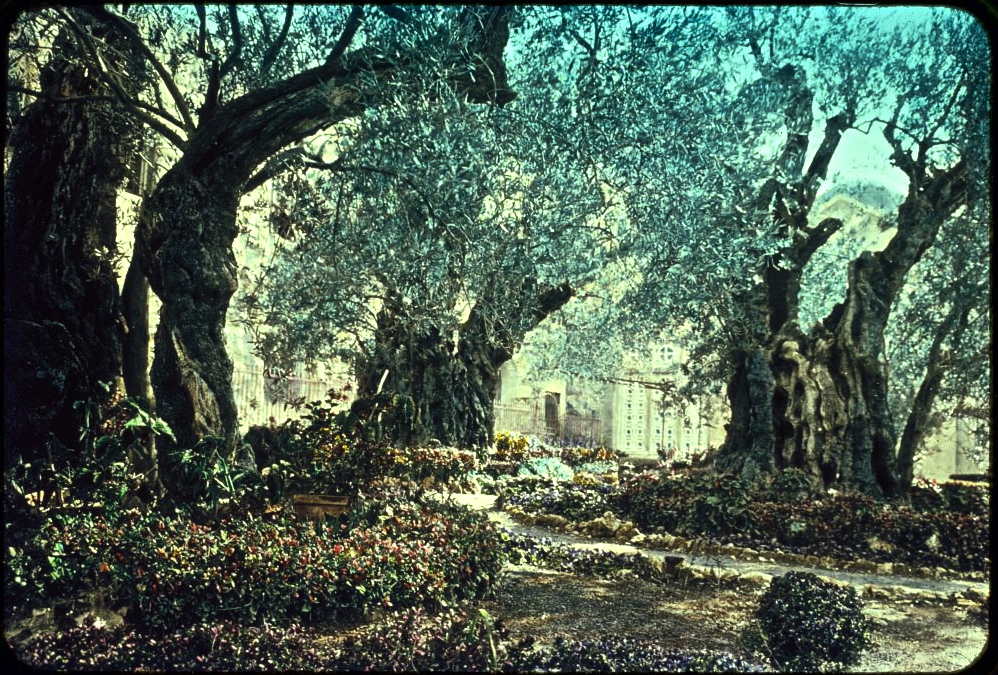
“Garden of Gethsemane semi-distant with overhanging olive branch,” c. 1898-1946.  The garden is in the middle of the photo.  Click the image to enlarge it.

‘Gethsemane’ is a Greek word derived from an Aramaic word for ‘oil-press.’ The Roman Catholic-administered garden is located at the foot of the Mount of Olives. It is one of four locations in the area currently claimed by different religions as the place where Jesus prayed the night before the crucifixion.

“Jerusalem. Gethsemane from convent roof showing city wall and Golden Gate.” Image hand-colored c. 1950 – 1970, but original black and white photo was probably taken earlier.

In the gospels of Matthew and Mark, it is called by a word meaning ‘place,’ ‘property,’ or ‘estate.’ In the gospel of John, the Greek word ‘kepos’ is used; it can mean ‘garden,’ but also ‘cultivated tract of land.’

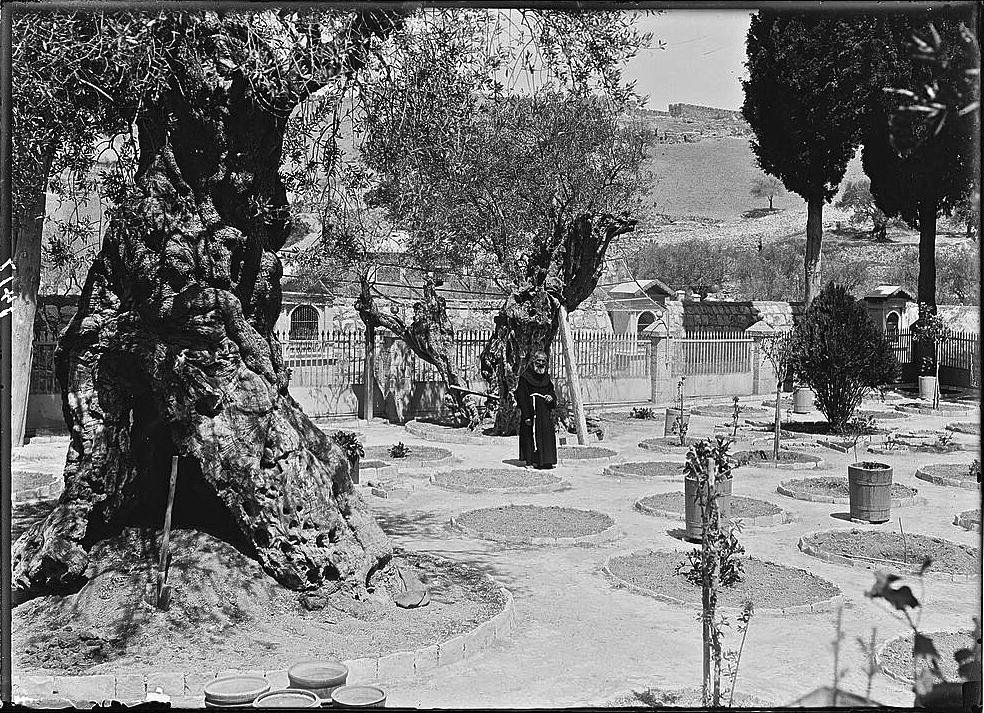
“Garden of Gethsemane, inside enclosure.”

The first recorded pilgrimage to the site was made in 333 A.D. by the anonymous “Pilgrim of Bordeaux,” who recorded his travels in the Holy Land in Itinerarium Burdigalense.

“Jerusalem (El-Kouda, Garden of Gethsemane, interior),” c. 1898-1914.

The building attached to the garden, the Church of All Nations, was built in the 1920s. The garden’s olive trees are said to be 2,000, 1,000, or 900 years old, depending on the source.

“The terrible plague of locusts in Palestine, March-June 1915. The same garden after visitation by the locust.”

In 1915, a plague of locusts swept through Palestine, stripping areas — including the garden — of all vegetation. The American Colony was asked to photograph the devastation, which caused food shortages, by the Ottoman-Turkish governor for “Syria and Arabia.”

The Garden of Gethsemane remains a popular tourist and pilgrimage destination today.